
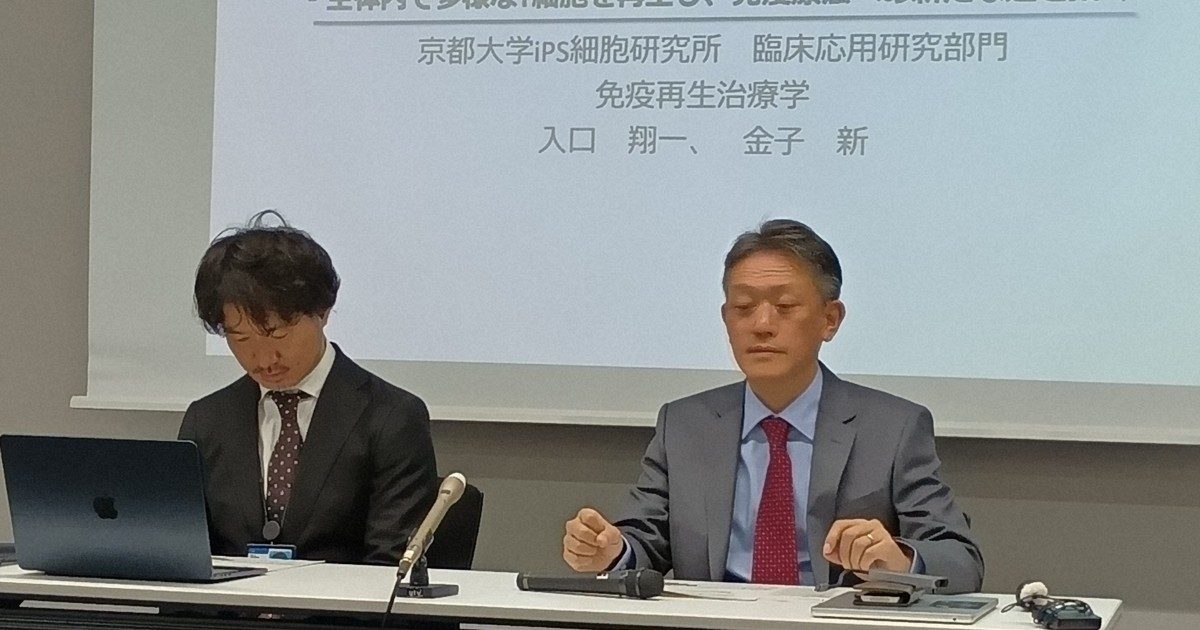
A Kyoto University team has developed a technique to make T-cell precursor cells from human iPS cells (induced pluripotent stem cells) at high efficiency, a step toward replenishing the body's own immune cells for therapy, the Mainichi Shimbun reported.
The group is led by Shoichi Iriguchi, a lecturer, and Professor Shin Kaneko of the clinical application department at the university's Center for iPS Cell Research and Application (CiRA). The findings were published online on the 21st in the US journal Cell Stem Cell.
The researchers confirmed in mice that the cells settle in the thymus, the organ where T cells mature, and can develop along the same path as naive T cells. Naive T cells are the immature cells able to respond to a wide range of antigens, the foreign substances the immune system targets.
The work points to a way to restock the body with a diverse set of T cells and opens a new route for immunotherapy, the team said.
A different route from lab-grown T cells
Kaneko's group has been working on making immune cells such as T cells from iPS cells for use against cancer and infectious disease. It previously developed a method that matures T cells outside the body and engineers them to attack only a specific target before they are given to patients. A clinical trial is expected in 2027.
That approach struggled to secure mature T cells that take hold in the body for a long time and can adapt to a variety of targets. In the body, the thymus accepts T-cell progenitors produced in the bone marrow and other sites and raises them into mature T cells.
The group's new method produces those progenitors, known as thymus-homing T-cell progenitors, from human iPS cells at high efficiency.