
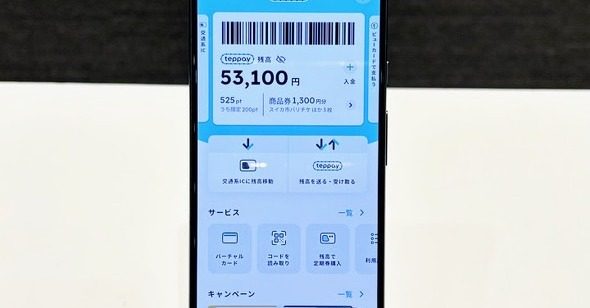
JR East released teppay, a code payment service, on October 20. It runs inside Mobile Suica, the app that lets users tap their Suica transit card from a smartphone, and its selling point is that users can charge more than Suica's ¥20,000 top-up limit.
JR East is aiming to pull in Mobile Suica's more than 45 million users and strengthen an economy built around the railway. Payment is by code only: teppay does not support the tap-to-pay contactless function that made Suica a household name.
Charging the balance with a credit card is restricted to View Card, the card JR East group issues. User reaction has been mixed.
How teppay works
Users switch screens inside the Mobile Suica app. Besides paying, they can send balances to one another and buy commuter passes. In spring 2027 the service will extend to Mobile PASMO through a tie-up with PASMO, the company behind the other major transit IC card, based in Shinjuku Ward, Tokyo.
At stores, payment works the way it does with PayPay: either the shop scans a code shown in the app, or the user scans a QR code at the till. Teppay works at shops displaying the teppay mark or the Smart Code mark, and the number of participating stores exceeds 1.7 million.
Smart Code is a payment system provided by JCB, also used by Wesmo!, the payment service West Japan Railway released in 2025. Teppay codes are still rare on shop counters, but because Smart Code is accepted, the service works at major convenience store chains, electronics retailers and restaurant companies. The store count is still below PayPay's, which stood at 2.35 million as of March 2023.
Chasing larger payments
JR East announced in December 2024 that it would add a code payment function above Suica's ¥20,000 limit, and in November 2025 it gave the service the teppay name. Suica works in and around stations, but people making large payments had been going to credit cards and other payment services.
Teppay sets separate ceilings per payment, per day and per month. Users who complete identity verification and charge from a bank account can load ¥100,000 at a time, ¥150,000 a day and ¥300,000 a month. Users who have not verified their identity are capped at ¥50,000, ¥100,000 and ¥100,000.
JR East has told reporters that Suica's ¥20,000 ceiling exists to prevent fraudulent use and for security. When the service began in 2001, cashless payment was far less widespread than it is now, and the aim was to save people the trouble of handling coins.