
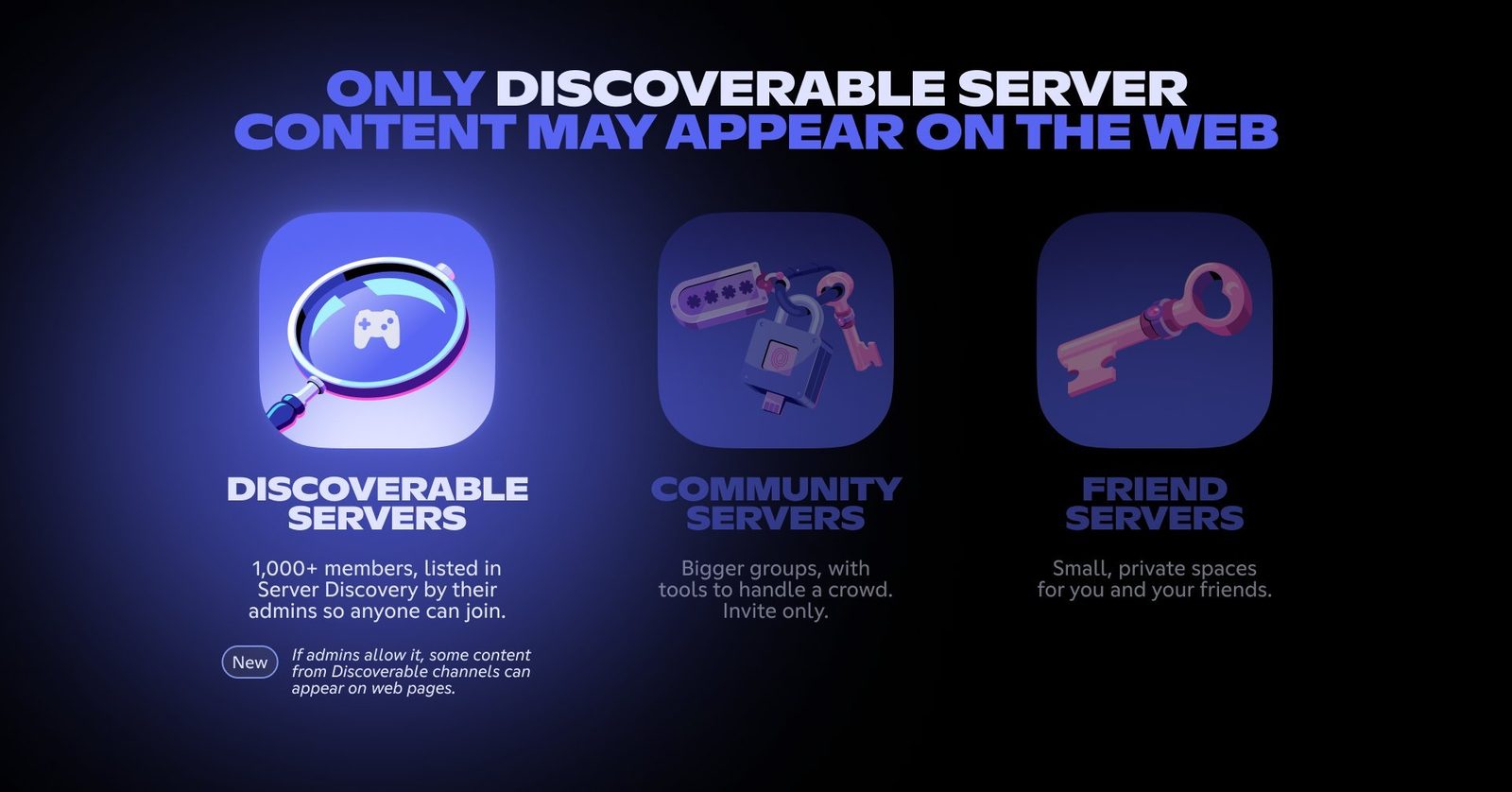
Discord will make conversations in some of its public communities findable through search engines including Google, the company said on October 27. Automatic summaries of conversations go public from November 16, and the posted messages themselves become searchable from mid-December.
The change covers "Discoverable Servers" — communities of 1,000 or more members that administrators have set so anyone can join without an invitation. More than 63,000 such servers exist. Invite-only servers, direct messages between users and group DMs are not affected.
Discord is widely used for online communities built around games and hobbies. Users join a "server" and talk by text or voice in topic-specific "channels" within it. The company says the aim is to make information that has been buried inside Discord, such as game strategies and fixes for technical problems, easier to find through ordinary web search.
Summaries in November, message text in December
From November 16, every discoverable server gets a public "server web page". Alongside an overview of the server, the page can carry "channel summaries" — conversations in public channels condensed by AI. Only conversations from November 16 onward are summarized.
From mid-December, the text of messages posted in the selected channels will appear on the web page as "channel messages" and be findable in Google results and elsewhere. Posters' usernames and avatar images are not shown. Messages posted before mid-December are excluded.
Server administrators can choose which channels are published, but public channels are selected by default. An icon marks each channel that is public.
Privacy and AI training concerns
The change has drawn concern that conversations will spread beyond the audience they were meant for. TechCrunch reported pushback from users who say remarks in public servers were not necessarily meant for the whole internet, and worries that conversations could be used to train AI models.
The risk may be sharpest for people who use online communities to discuss personal problems while staying anonymous, or to keep themselves safe. Even without usernames, the content and context of what someone writes can identify them.
Once search engines can reach the conversations, there is also concern that the material will be scraped without permission as AI training data. Discord says in its official help pages that it does not sell users' messages to AI companies. That does not guarantee published content will not be collected and used by outside AI firms. Discord itself uses AI to generate the summaries.
Avoiding publication takes a settings change
Users can stop their messages appearing on the web pages by turning off "Show message content from discoverable channels on web pages" under "Data & Privacy" in User Settings. The setting applies to every discoverable server a user belongs to.
Turning it off does not withdraw messages posted while it was on; those stay public. To prevent publication, or to remove a message already published, the original post has to be deleted on Discord. Removing it from search engine caches and results can take longer still.
The personal setting controls only the message text, not the automatic summaries. To keep summaries private as well, a server administrator must disable "Channel Summaries" and "Channel Messages" separately under "Web Presence" in Server Settings, then Community. A server can also be taken off the web entirely by reverting it from a discoverable server to an invite-only community server.
Legal restrictions mean message publication is off by default in the EU, the UK, Canada, Brazil, Australia and South Korea. In Japan and other regions it is on by default. Messages from teenage users are excluded.