
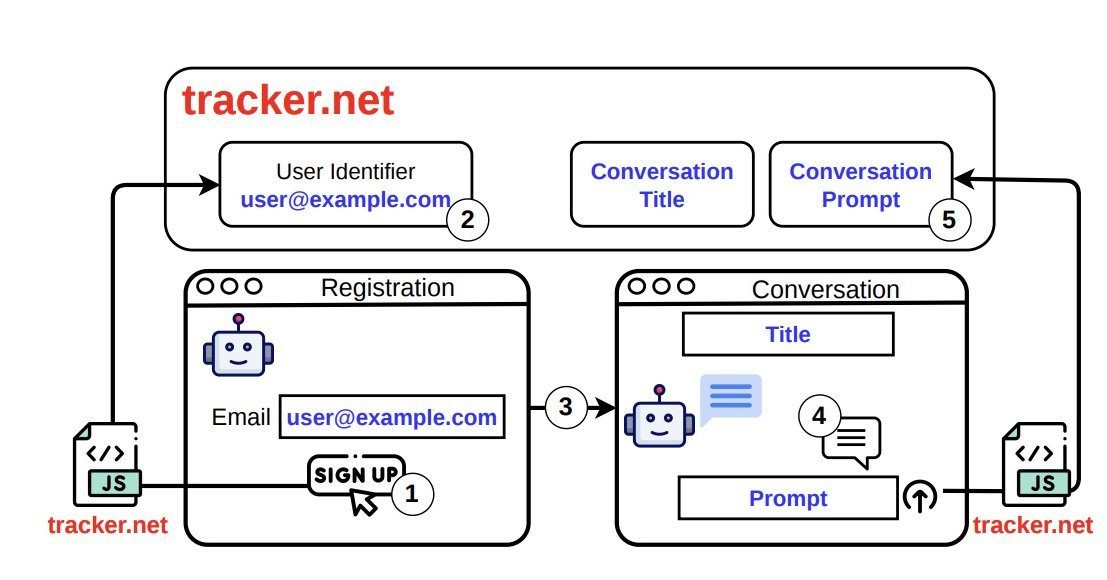
Researchers at Stony Brook University found that 21 of 42 AI chat services leaked conversation summaries to outside trackers, and nine sent users' prompts out verbatim, ITmedia News reported.
The study, titled "Penny for Your Prompts: A Measurement Study of Contextual Leakage in AI Chat Platforms," has been accepted to IEEE S&P 2027. It covers 25 general-purpose AI services, including ChatGPT, Claude and Gemini, plus 17 specialized in health, law and education.
People turn to AI chatbots with everyday questions, symptoms, legal problems and personal worries, expecting the exchanges to stay private. Under the hood, though, many of these services carry the same ad-delivery and behavior-analytics tracking programs as ordinary shopping and news sites.
How the data escapes
The team did not simply log outbound traffic. It traced the browser's JavaScript engine in detail, pinning down which user action triggered a leak, which part of the page the data came from, and where it was sent.
The trackers are not hacking anything. They run the same function ordinary websites use to grab a page's title tag automatically.
Most AI chatbots summarize each question into a new conversation title and display it as the page title. When a tracker fires as a prompt is sent or the user switches chats, it reads that title as a page name and ships it out.
Raw prompts traveled by other routes: session-recording tools that harvest on-page text, and designs that place the prompt inside the URL.
Email addresses and Google's share
Among the services where conversation content leaked, 11 of 13 general-purpose chatbots and all eight specialized ones also sent the email address entered at sign-up to outside parties.
For the 25 general-purpose services, about 22 percent of the average 540 browser requests per service, or 118, went to trackers. Google received 41.8 percent of them.
- Google: 41.8%
- Microsoft: 12.2%
- ByteDance: 8.6%
- Meta: 8.3%