
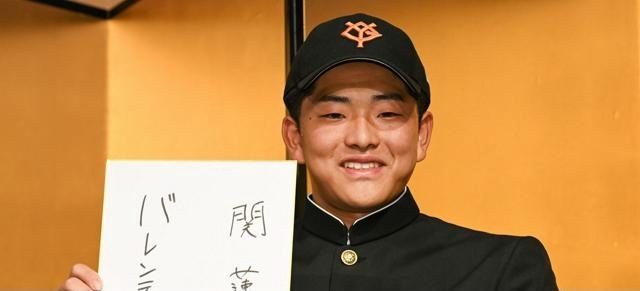
Rentaro Seki, a catcher taken by the Yomiuri Giants in the fifth round of the developmental draft at 14, the youngest player ever selected, received the formal drafting greeting at his school in Kawasaki on Wednesday. It is the first time a junior high school student has been named in the draft in its history, which began in 1965, including the developmental rounds.
Seki is in the first intake of the Giants U15 Junior Youth, a hardball team the club set up for junior high students and registered with the federation as the Tamagawa Boys. He captained Japan at this year's U15 World Cup and helped the team to a bronze medal. He also played for the Giants Junior side as a primary school pupil.
A contract, a dormitory and a full-time high school
After the greeting, Seki appeared at a news conference with Takeshi Omori, the representative of the U15 team. Asked why he chose to turn professional out of junior high, he said the chance to join the Giants outweighed the alternative of high school baseball.
“Going to Koshien and playing high school baseball was an option, but joining the Giants was the biggest choice for me. I want to become the professional player I am aiming for, a top-class player.”Rentaro Seki, Giants developmental draft pick
He will sign a developmental contract once he has finished compulsory education and will live in a Giants dormitory while attending a full-time high school. The plan is to train at the club's facility after class on weekdays and with the Giants' third team at weekends. He will not belong to a baseball club affiliated with the Japan High School Baseball Federation.
Omori, who played for the Giants and other clubs, cited the latest equipment and training environment that allow a scientific approach. "He can be taught by professional coaches," he said. "Not just skills — he can learn what it means to be a professional, ahead of players who join through the high school draft."
Seki started baseball around the second grade of primary school, following his older brother. He described his strengths as a strong arm and, at the plate, power and the ability to make contact. His favorite player is Wladimir Balentien, who hit a record 60 home runs in a season for Yakult in 2013.
“A player with power. He is a goal for me, someone I respect.”Rentaro Seki
The day after the draft, the Giants confirmed Hideki Matsui as their new manager. Seki said he was startled when he heard. "I thought he was an amazing player when I was small, so I was surprised when he became manager," he said. "If there is time, I want to ask him about how he played and how he hit."
His first target is a place on the 40-man roster. "I want to aim for the roster in four or five years, working through third-team games and practice," he said. He added that he wants to keep moving forward a step at a time.
Why a junior high student can be drafted
Under the agreement governing Nippon Professional Baseball, a player expected to graduate from junior high is eligible to be drafted. Players at schools affiliated with the Japan High School Baseball Federation or the All Japan University Baseball Federation must submit a notice of intent to turn professional; junior high students do not.
The rules on the rookie selection meeting bar a player from having a contract approved until compulsory education is complete. Until he is formally listed as a developmental player, his activities are restricted.
According to the Baseball Hall of Fame and Museum, Michio Nishizawa turned professional at 14 as a trial player with Nagoya, now the Chunichi Dragons, before the war. Since the draft began in 1965, Hanshin took pitcher Kento Tsujimoto in the eighth round in the autumn of 2004, when he was 15 and at a high school in the United States.
Other domestic professional sports set their own limits. The J.League lowered the age at which a player can sign a professional contract in April, from 16 or over to the first April 1 after a player turns 15. In sumo, completion of compulsory education has been required to sit the new-recruit physical since 1973.
Matsui said the Giants bear a duty to make the move work for Seki. "It would be good if, a few years from now, he can look back and be glad he made the decision to go into the professional game," he said. "We want to take responsibility for making that happen."