
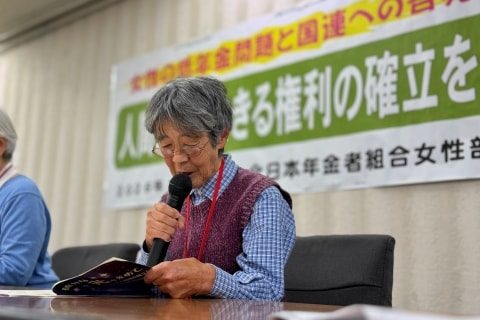
Japan's low pensions for women amount to structural human rights violations born of long-standing gender discrimination, the All Japan Pensioners' Union said on November 9, announcing it had lodged a complaint with the International Labour Organization and other bodies.
The union made the announcement at a press conference for reporters covering the health and labor ministry in Kasumigaseki, Tokyo. It said the ILO had issued a "direct request" asking the Japanese government to explain how pensions are calculated and how the "macroeconomic slide" — the mechanism that trims benefit levels — works.
Takako Takahashi, 84, who worked for 35 years, also spoke at the conference. "Pensions have not caught up with rising prices at all, and I am truly anxious about the future," she said, describing a life lived by drawing down her savings.
After 35 years of work, her pension comes to about ¥100,000 a month after deductions.
A gap that tracks working life
The union points to the low amounts women receive. Its materials, citing health ministry statistics, show about 4.74 million men (31.73%) receive less than ¥100,000 a month, against about 16.53 million women (81.31%).
A further 4.15 million women, or 20.4% of the total, receive less than ¥50,000 a month.
The union argues that structural sex discrimination during women's working years produced this gap. Women were long expected to leave their jobs on marriage or childbirth, and those who stayed on earned less than men and had fewer chances of promotion.
Women who left work to raise children or care for relatives often had to take low-paid non-regular jobs when they returned. Those differences in working life carried through into pension contributions and then into the size of the pension, the union says, feeding poverty among older women.
Below the welfare line
The conference also raised the case of older people living on pensions that fall below the welfare standard. The Public Assistance Act exists to secure the "minimum standards of wholesome and cultured living" guaranteed by Article 25 of the Constitution.
"A pension lower than at least that standard is a disregard for human rights, isn't it?" the union said. It asked: "Can you live in Japan today on ¥100,000 a month or less?" Hardship varies with whether a person owns a home, the union said, but the current level of benefits is too low.
To fix this, the union wants a minimum guaranteed pension — a floor under retirement income. Under the present public pension system, payouts are set in principle by how long a person paid in and how much they earned while working, so some people who worked for years still receive too little.