
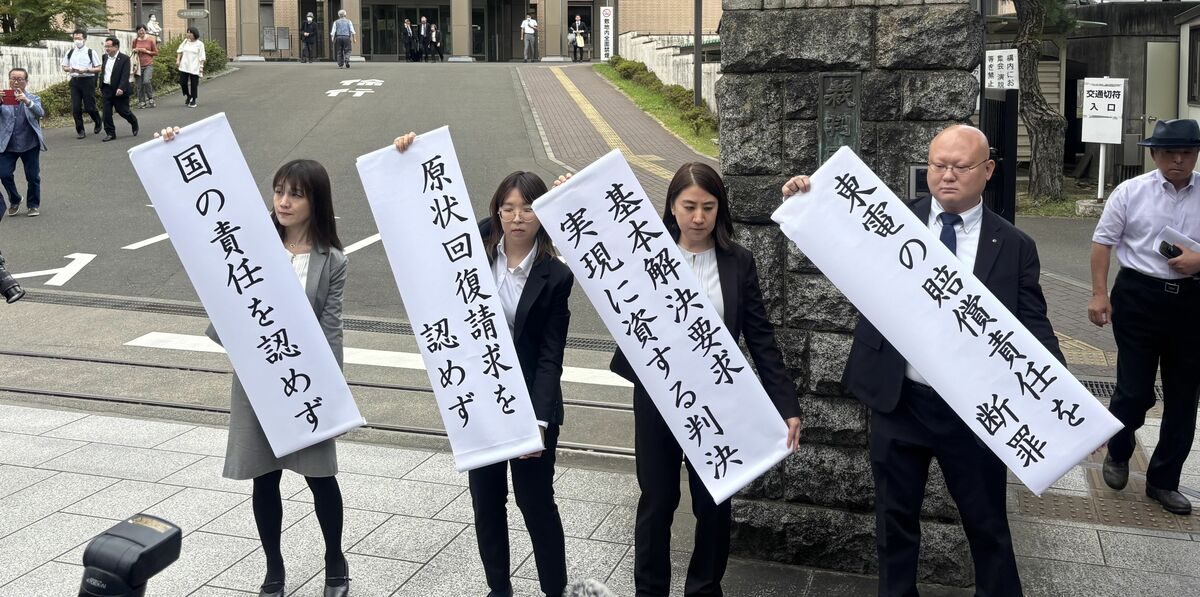
A court has again declined to hold the state responsible for the Fukushima No. 1 nuclear disaster, even though TEPCO's own engineers concluded that tsunami countermeasures could not be avoided. The Sendai High Court ruled on October 16 that the government could not have foreseen the tsunami that flooded the plant, in an appeal brought by residents of the Tsushima district of Namie, Fukushima Prefecture.
Presiding Judge Yosuke Ishigaki's court rejected the state's liability. On October 28, the Tokyo District Court reached the same conclusion under presiding judge Masahiko Abe.
The Tsushima case had gone the other way at first instance: in 2021, a lower court found the state responsible. Since the Supreme Court ruled in a similar case in June 2022 that the state was not liable, courts around the country have followed that decision, and the rulings have read like degraded copies of it.
A 15.7-meter estimate against a 10-meter site
At issue is the reliability of a tsunami forecast published in 2002 by the government's Headquarters for Earthquake Research Promotion, known as Jishin Honbu, which issues long-term evaluations of seismic risk.
Working from that evaluation, TEPCO produced a 2008 estimate that a tsunami of 15.7 meters could strike the Fukushima No. 1 plant. The ground where the main reactor buildings stand is about 10 meters above sea level.
The Sendai High Court held that because the long-term evaluation was disputed, it "cannot be recognized as having had the precision and accuracy to be adopted immediately into nuclear regulation." It concluded that it was "hard to say" the plant could have foreseen a tsunami large enough to overtop the site and flood the facility.
TEPCO's own staff saw the risk
That reasoning sits badly with what TEPCO's engineers themselves had concluded. Even after weighing the objections, they judged that the tsunami risk described in the long-term evaluation had to be prepared for. Engineers who wanted to keep the assumed height as low as possible still believed the evaluation had to be adopted.
A document prepared by a TEPCO employee in September 2008, three years before the accident, put it plainly: "Considering that it is difficult to completely deny the views to date of academic experts on earthquakes and tsunamis and the knowledge of the Jishin Honbu [the long-term evaluation], it must be assumed that a larger tsunami height than at present has to be evaluated, and tsunami countermeasures are unavoidable."
The Supreme Court's June 17, 2022 ruling found the state not liable, but it described the tsunami estimate based on the long-term evaluation as "a calculation that took sufficient account of safety, allowed a margin, and corresponded to the worst case conceivable at the time, and was therefore reasonable." It did not flatly deny foreseeability, as the Sendai High Court did.
By going a step further than the Supreme Court, the Sendai court appears to have got it wrong.