
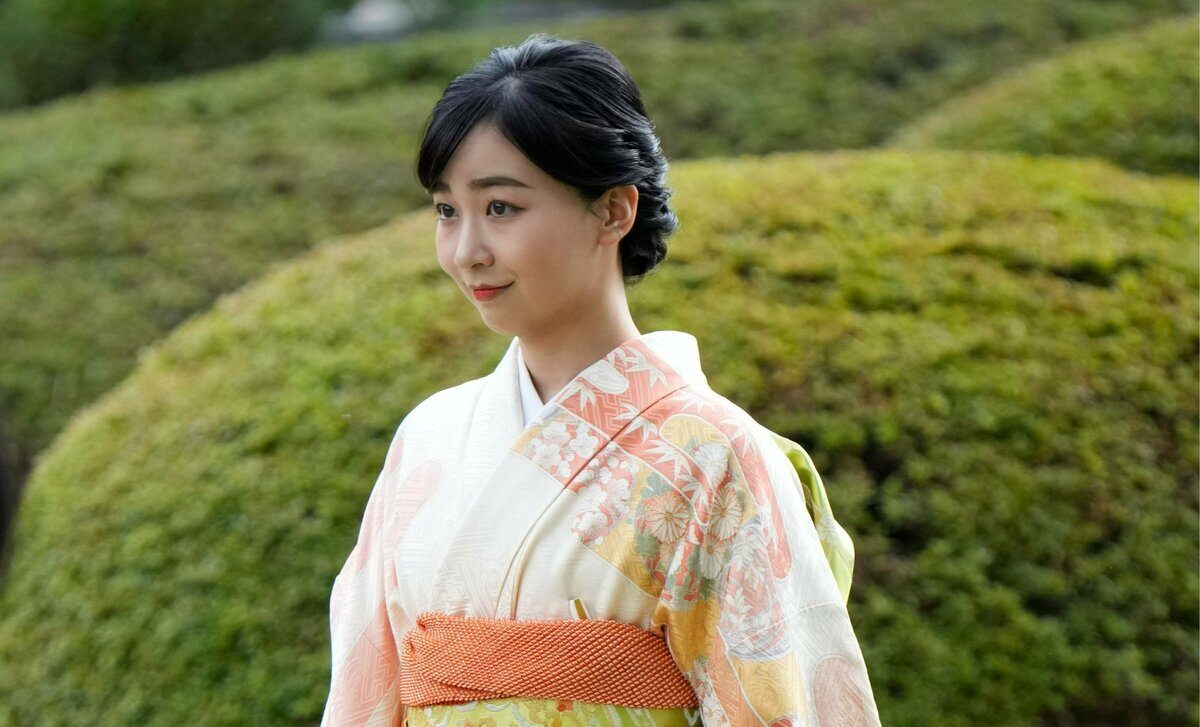
Princess Kako, the 31-year-old second daughter of the Akishino family, wore a furisode — the long-sleeved formal kimono associated with unmarried women — to the autumn garden party. Social media lit up with praise, and with a sharper question: "Furisode at 30?" The online commenters who police kimono etiquette, known in Japan as "kimono police," had found a new target.
The party was held on October 29 at the Akasaka Imperial Gardens in Moto-Akasaka, Tokyo. Princess Kako's kimono was a pale cream with pink patterns, and her obi — the wide sash tied at the back — was a yellow-green that suggested the turning season. A ring that appeared to be pearl set off her right middle finger.
Alongside the compliments online came posts asking whether furisode was appropriate past 30, and suggesting a woman in her 30s should wear a tomesode, the shortened-sleeve formal kimono worn by married women.
No rule, the professor says
Naoko Kondo, a professor at Bunka Gakuen University who chairs the Ministry of Economy, Trade and Industry's Japanese dress promotion council, said no such rule exists. "Furisode is generally regarded today as the first formal dress of an unmarried woman, so if you are unmarried, it is basically fine," she said.
Whether the garment suits the wearer is another matter, she added. "Furisode is clothing with a youthful energy. Even if a woman is unmarried, I do wonder about someone of advanced years wearing one. Given Princess Kako's character and air, it suits her very well. It is a kimono appropriate to a garden party, which is a highly formal occasion."
A garment that began with children
Kondo traces the idea that furisode must be shed at 30 to an older image of unmarried women as being in their 20s. The garment's origins lie elsewhere. "In the Edo period it was clothing for small children, whose body temperature is high," she said.
The forerunner of the furisode had openings at the sleeve seams and under the arms that let heat escape. Most kimono worn by children at the Shichi-Go-San rite, which marks ages three, five and seven, are furisode today. Early modern paintings show young women in the garment, but it took hold as formal dress for coming-of-age ceremonies during the period of rapid economic growth.
What counts as proper in kimono has shifted with the times, Kondo said.