
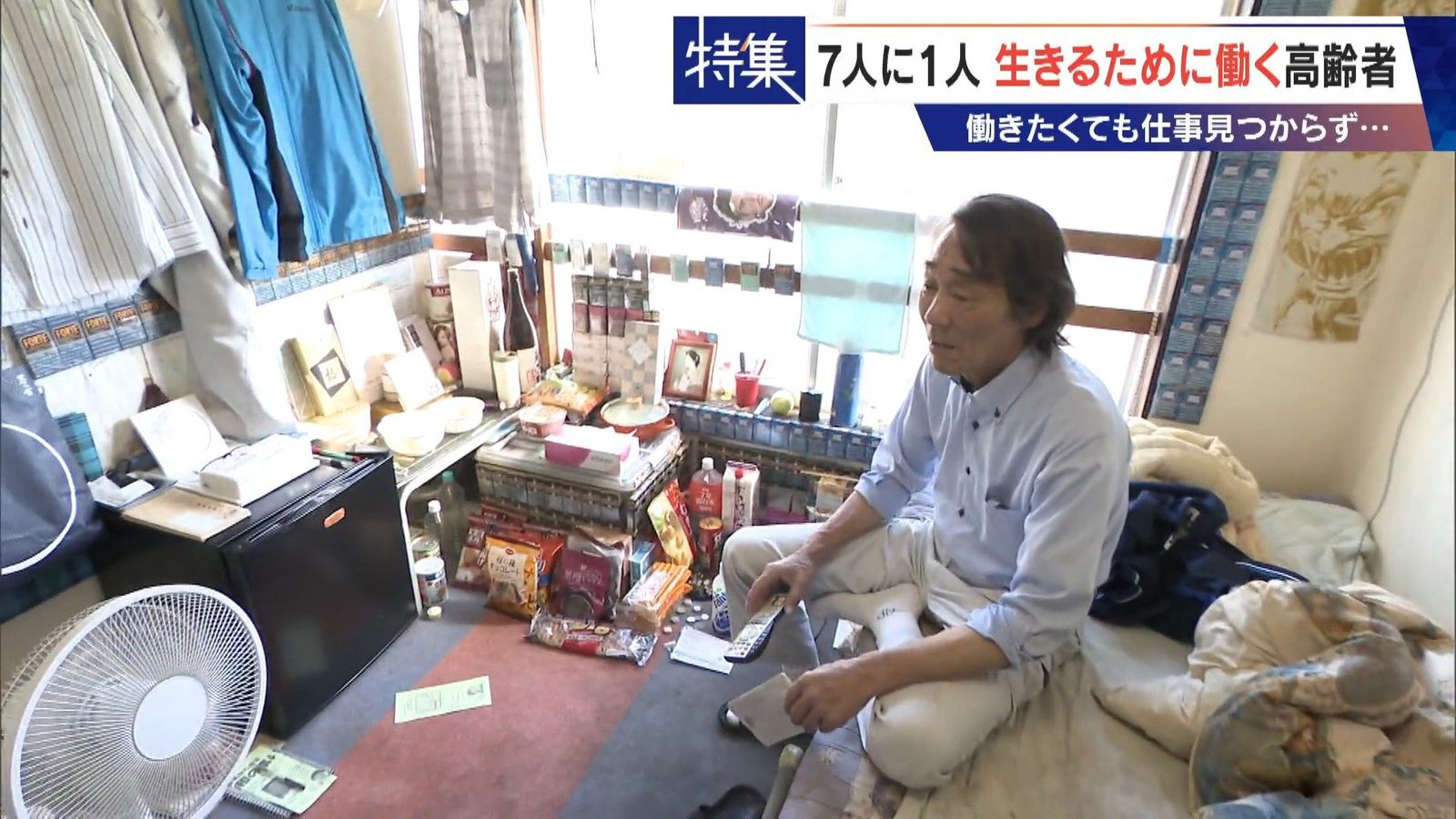
A man in his 70s in Aichi Prefecture works about 25 days a month and has roughly ¥40,000 left after rent, because his pension of about ¥50,000 a month will not cover his living costs, CBC TV reported.
The man, identified only as A, lives in Ichinomiya. He drove a taxi for more than 25 years in Chiba before a traffic accident forced him to quit.
He now does delivery work for a food-support operation. He collects disaster stockpile goods nearing their expiry date from a city hospital and takes them to the Nowami Consultation Center, a welfare support group in Ichinomiya.
The center gives donated food to people in financial trouble free of charge three days a week. A is paid by the job, and he also receives food support there himself.
¥20,000 a month, and a hernia
His income comes to about ¥20,000 a month. The apartment he lives in was arranged through the center, after repeated visits to a Hello Work public employment office turned up no work.
His pension notice shows about ¥50,000 a month. Rent, meals included, takes ¥3,000 of it, leaving ¥20,000 for everything else.
“I can't do it. Nobody is living an easy life. So I work, and ¥40,000 a month is the absolute limit.”A, man in his 70s
A has a hernia and keeps working through it. "I have to put up with the work. My muscles still hurt a lot," he said.
943 million workers aged 65 and over
The Internal Affairs Ministry counts 9.43 million workers aged 65 and over, a record and the 22nd straight year of increase. About one in seven workers in Japan is now 65 or older.
About 76% of them are non-regular employees such as part-timers. In a fiscal 2024 survey on the economic life of older people, about 55% of that group said they work to live.
The Nowami Consultation Center began with support for homeless people. In recent years it has seen a rapid rise in requests from older people who were living ordinary lives, director Norimichi Miwa, 79, said.
“Now it's mostly older people. The pension alone won't feed them, and prices keep going up, so food support keeps growing.”Norimichi Miwa, director of the Nowami Consultation Center
'I turned the gas off'
The center also helps people find work. Requests for help have jumped 40% to 50% in recent years, reaching about 300 people on a busy day, many of them older.
A woman in her 70s said her pension falls short, so she wants to work. She quit her job after a city checkup found two cancers.
A man in his 70s gets ¥70,000 to ¥80,000 a month. "It's not nearly enough," he said. Asked what he goes without, he named baths: "Gas is a waste, so I turned it off." Another woman in her 70s said she cannot live on her pension. "I can't buy anything. I have no choice but to come here."
A stroke, then construction work
A woman in her 70s, identified as B, still works on construction sites. She had a stroke and spent about three months in hospital. Her left side is partly paralyzed, and rainy days are hard.
Asked whether she has to draw down savings to live, she said: "I can't live. It's hard."
For older people living alone, the center acts as guarantor and emergency contact for apartment rentals and visits after they move in. "Many are older, so some are found collapsed at home. That's why we check in regularly," Miwa said.
A week's worth of supplies
Two large trucks arrived at the center one day with 534 cases of juice and 350 cases of hardtack from another support group. The load was stacked outside the building.
“It will be gone in a week. More and more people are in severe hardship. That's the kind of society we've become. A place like ours should disappear quickly. We've run 30 years, and it keeps growing.”Norimichi Miwa, director of the Nowami Consultation Center