
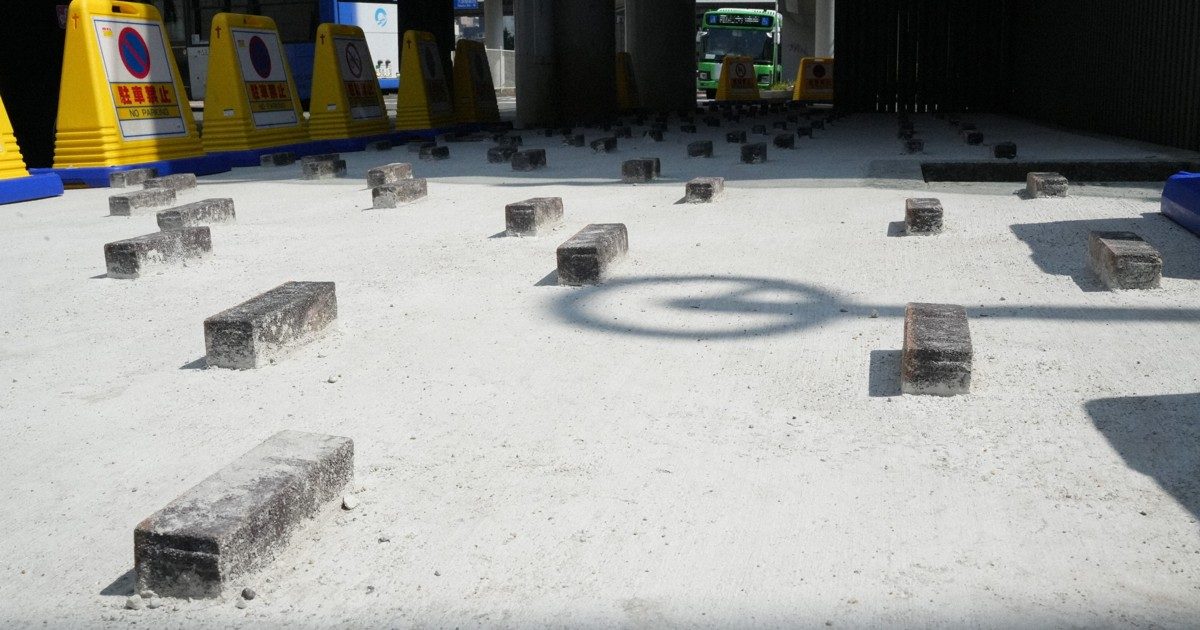
Blocks embedded in a space in front of JR Osaka Station this summer drew criticism on social media that they were "exclusion art" meant to drive homeless people away. Osaka city, which installed them, has been left explaining that the measure was intended to keep people from entering the area and that countering homelessness was not its only purpose.
Taro Igarashi, a Tohoku University professor of architectural history who wrote the book "Exclusion Art for Whom?", visited the site in August. "This should really be called design, not art. It is primitive exclusion design," he said.
Such structures appeared overseas by at least the 1980s, where they were called "hostile architecture," according to Igarashi. They began drawing attention in Japan in the 1990s.
In 1996, after the removal of a "cardboard village" where homeless people gathered in an underground passage at Shinjuku Station in Tokyo, about 600 cylindrical objects were laid across the space.
Beyond Osaka
Structures described as exclusion design have been installed elsewhere around the country. At Wakamiya Odori Park in Naka Ward, Nagoya, several house-shaped frames stand in the space beneath an elevated railway. At Wave Plaza outside the west exit of Shibuya Station in Tokyo, small pointed posts and cylinders of varying sizes stand in rows.
Benches divided by partitions so that people cannot lie down are a common sight in parks across Japan. Igarashi said such designs are made mainly to address homelessness, but that they make sitting and staying uncomfortable for everyone, becoming a latent attack on people who are frail, elderly or pregnant, and on people displaced in disasters.