
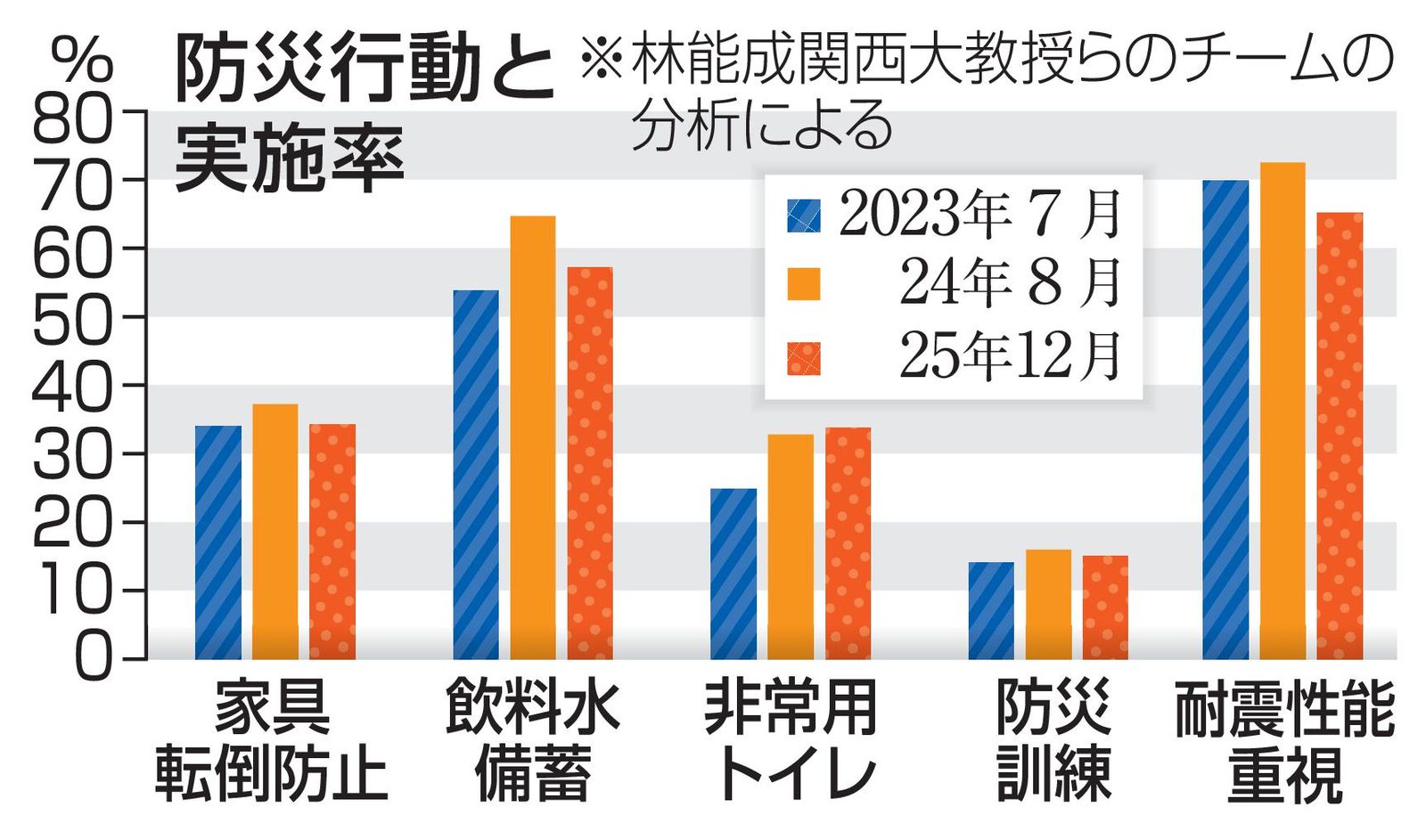
Japan's Nankai Trough Earthquake Extra Information — an advisory issued when the chances of a megaquake along the trough have risen — did not shift how much people actually did to prepare, according to a survey by a team led by Kansai University professor Yoshinari Hayashi, who studies earthquake disaster prevention. The team's findings were reported on the 5th.
Stockpiling of drinking water rose from 53.8 percent to above 60 percent after the 2024 advisory, then fell back to 57.2 percent, the survey found. Rates of other measures, including securing furniture against toppling, showed little change.
Disaster Management Minister Go Hosono issued an "emergency request" on the 2nd, as the new Disaster Management Agency was launched, urging the public to step up preparations in advance. Hayashi said the government's messaging on the advisory is ambiguous. "Please show us concretely the actions we should prioritize in order to protect our lives," he said.
How the survey was run
The advisory is issued when an earthquake of magnitude 6.8 or larger occurs along the Nankai Trough, among other conditions. It was issued in August 2024 and in January 2025.
Hayashi's team carried out five surveys of residents of Shizuoka, Aichi, Osaka and other prefectures between July 2023 and December 2025. From roughly 14,000 responses in total, they tracked how 18 types of preparation changed over time.
The team's results were reported on the 5th, the same day the findings became known.
The advisory tells the public that the likelihood of a major quake has increased. Whether people act on it depends on whether they know what to do first, and the survey suggests most did not change what they did.