
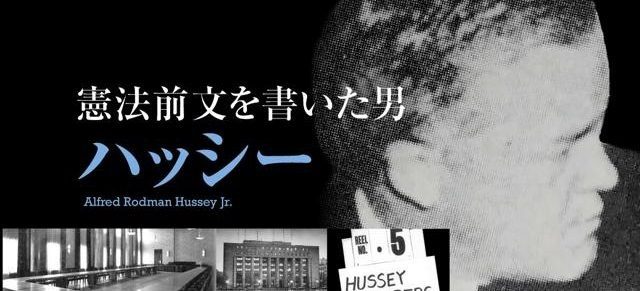
Alfred Rodman Hussey, a US Navy commander who helped draft Japan's postwar Constitution, wrote the document's preamble around a vision of peace as a right held by people everywhere. A constitutional scholar who has spent years studying the papers he left behind says that vision still has something to say to Japan.
Mika Honjo, an associate professor at Iwate University, spoke to the Asahi Shimbun about Hussey's documents and what they show about the preamble's origins.
What Hussey left behind
Hussey was assigned to the Government Section of GHQ — the General Headquarters of the Allied occupation — which pushed through Japan's democratization after the war. General Douglas MacArthur ordered the section to draft a new constitution, and Hussey became one of the officials who assembled it.
He also took charge of the preamble, writing in the principle of peace through international cooperation that became one of the Constitution's pillars. Hussey stayed at GHQ until 1948, working on Japan's democratization.
His ties to Japan outlasted the occupation. When calls to revise the Constitution emerged in the 1950s, after Japan regained its sovereignty, he dealt with a government constitutional research commission that visited the United States. He left a large body of records and reminiscences, and Honjo said much of it remains to be studied.
Peace as a human right
Honjo studied under Shoichi Koseki, an emeritus professor at Dokkyo University known for his work on how the Constitution was made, and her interest settled on the preamble. The preamble closely reflects the GHQ draft, she said, and Hussey's papers are essential to understanding it.
MacArthur's original instruction said only that Japan would entrust its defense "to the higher ideals now stirring in the world." Hussey developed that line in the GHQ draft's preamble, Honjo said.
In the text, the Japanese people declare that they trust the justice and faith of the peace-loving peoples of the world to preserve their security and survival, and affirm that all people have the right to live in peace, free from fear and want.
Asked about that right to live in peace, Honjo said it is indeed in the preamble as it stands today. Because the Constitution places the preamble and Article 9, which renounces war, far apart, the connection is hard to see, she said. Hussey's design, she argued, was for Japan to take the lead in international cooperation and make peace real as a concrete human right.
The Asahi Shimbun has been running a six-part series on Hussey, "The Man Who Wrote the Constitution's Preamble," which began on November 2 and runs through November 6.