
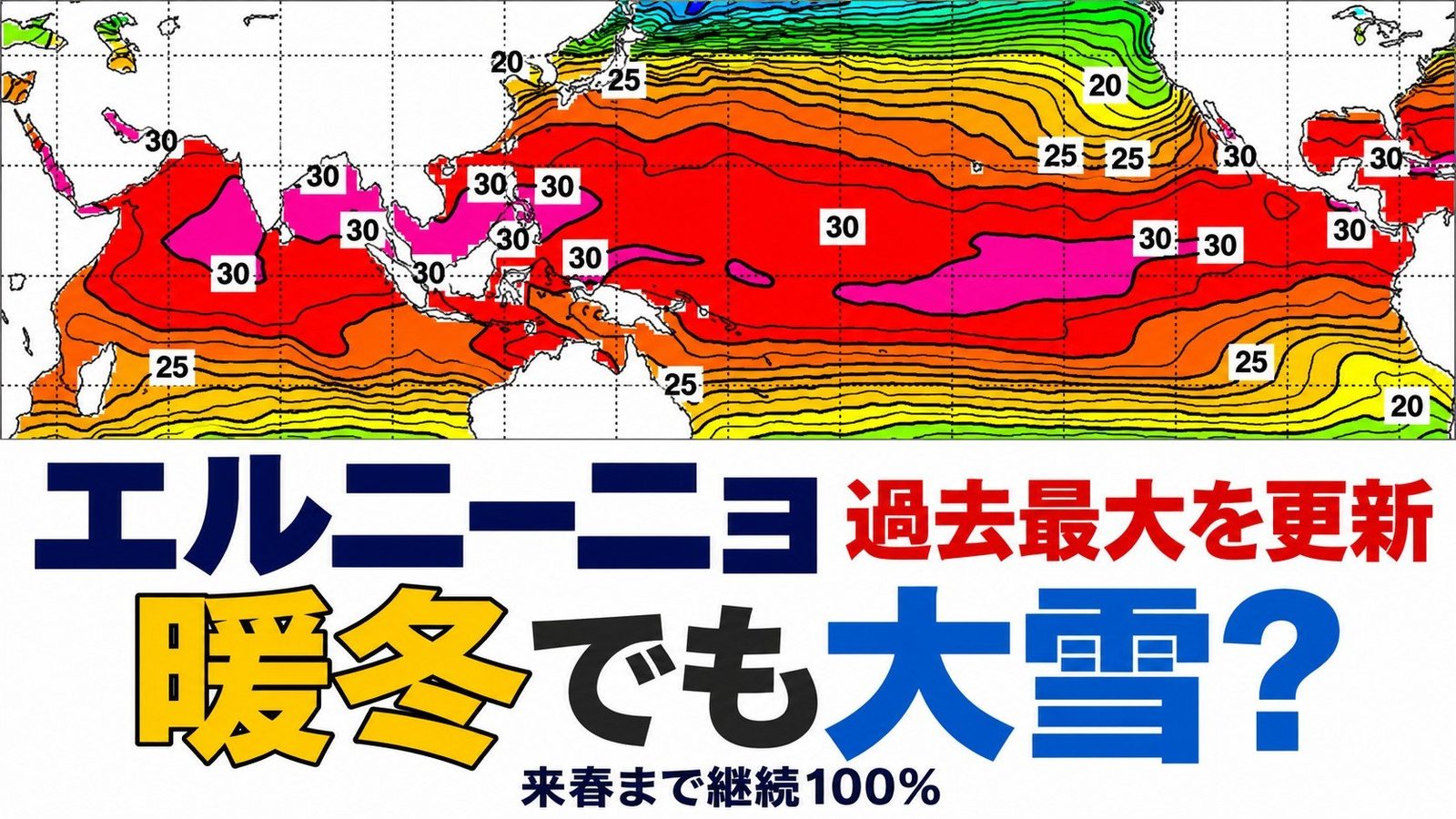
The El Niño that has run since spring 2026 set another record in October, the Japan Meteorological Agency said on November 10, and is expected to last into spring 2027 — a winter outlook that warns of warmth but not of safety from heavy snow.
In its latest El Niño monitoring bulletin, the agency put the chance of the phenomenon continuing through spring 2027 at 100 percent.
Sea temperatures 4.4°C above benchmark
Sea surface temperatures in the monitored area were 4.0°C above the benchmark in September. That passed the previous high of 3.6°C, set in December 1997.
In October the gap widened to 4.4°C, the highest for any month since records began in 1949. The record has now been broken two months running, MBC Minami-Nippon Broadcasting reported.
Unusually warm water also spreads deep below the surface in the central and eastern equatorial Pacific. The agency's forecast models show the pattern holding through the first half of winter, when El Niño is expected to peak.
The warm water is then expected to weaken gradually and its margin over the benchmark to shrink. Sea temperatures are still forecast to stay high into spring 2027.
Mild winters, heavy snow
Agency statistics show that winters during El Niño tend to bring average temperatures at or above normal in western Japan. Rainfall and snowfall tend to run high on the Pacific side of eastern Japan and in Okinawa and the Amami islands.
El Niño winters are often described as mild. Central Tokyo has nonetheless recorded 15 centimeters of snow in such a winter.
Forecasters point to low-pressure systems tracking along the southern coast and to cold air as the key factors behind heavy snow in an otherwise warm winter.