
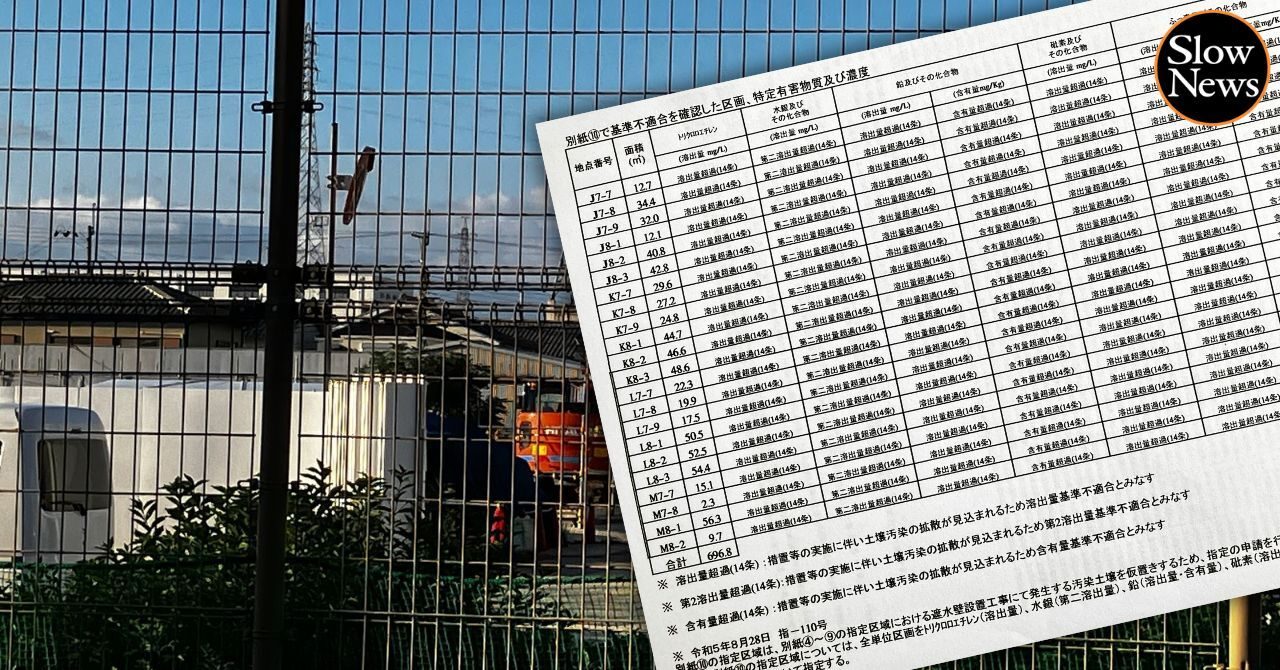
Soil at Daikin Industries' Yodogawa plant in Settsu, Osaka Prefecture, contains 24 of the 26 substances designated as hazardous under the Soil Contamination Countermeasures Act at levels above legal limits, according to the prefecture's register of contaminated sites. The plant is the subject of a pollution mediation request from nearby residents who say it is a source of PFAS — per- and polyfluoroalkyl substances, a class of chemicals linked to cancer.
The substances were buried underground in the past and came to light because Daikin carried out soil surveys required before large-scale construction. The work was part of efforts to stop PFAS from spreading, so the containment project exposed a separate contamination problem.
The plant covers about 410,000 square meters. Contaminated ground extends over 71,000 square meters, roughly a sixth of the site and about twice the area of Koshien Stadium.
What was found
The list includes trichloroethylene, arsenic, hexavalent chromium, cadmium and PCBs, all classified by the International Agency for Research on Cancer as carcinogenic to humans. Mercury, cadmium and PCBs are also known as the causes of Minamata disease, itai-itai disease and Kanemi oil poisoning respectively. PFAS is not covered by the register because Japan has no soil standard for it.
Daikin filed 20 soil survey reports between April 2013 and May 2026. Seventeen of them came after 2023, when work began on underground barriers to keep PFAS from spreading.
Some of the contaminated soil, which exceeded standards by a wide margin, was stored on site for more than a year in an area close to an elementary school and farmland.
Prefecture and experts differ
The Osaka prefectural government said groundwater nearby is not used for drinking and that measures to prevent scattering are taken once the hazardous material is dug up. On that basis it judged there is no health impact on residents outside the plant.
Experts dispute that conclusion. "It is premature to judge that there is no impact on that basis alone," one said.
“It is premature to judge that there is no impact on that basis alone.”an expert cited in the report