
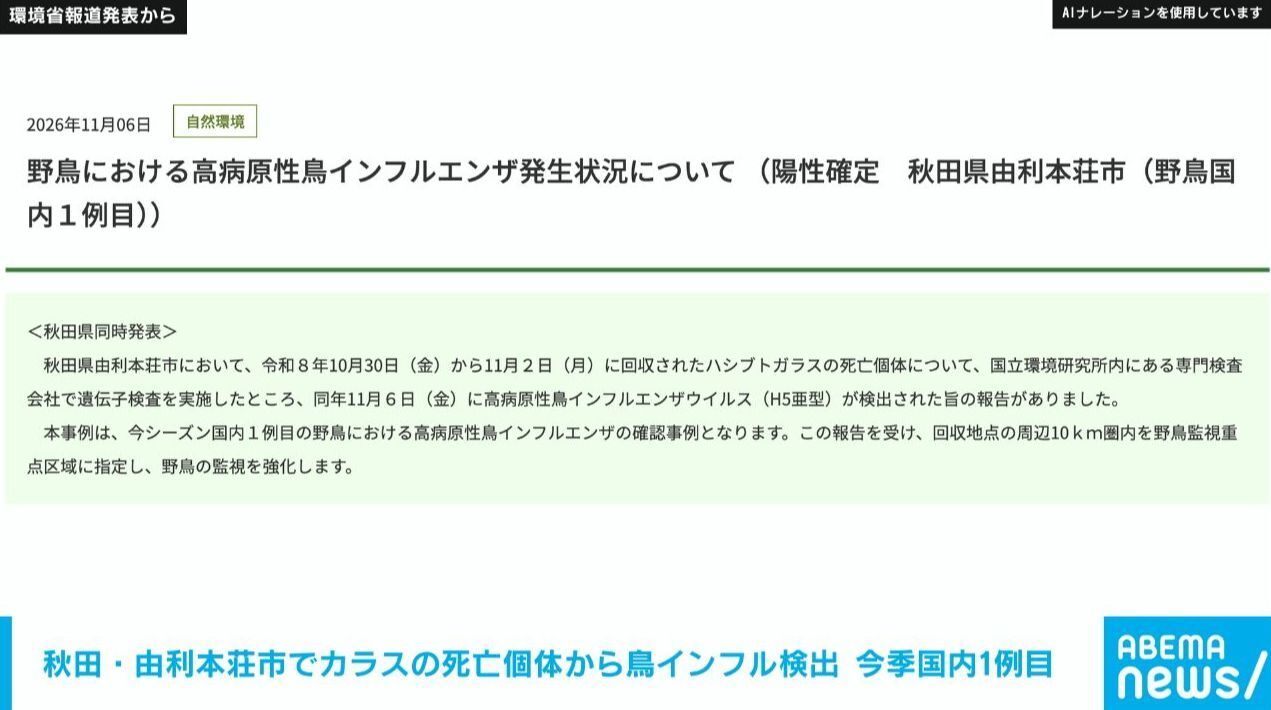
Japan has confirmed its first case of highly pathogenic avian influenza in a wild bird this season, after the H5 subtype of the virus was detected in a dead crow collected in Yurihonjo, Akita Prefecture.
The dead jungle crows were collected between October 30 and November 2. A specialist testing company at the National Institute for Environmental Studies ran a genetic test and reported the detection of the virus on November 6, according to the announcement.
In response, the area within 10km of where the birds were collected has been designated a priority wildlife monitoring zone, and surveillance of wild birds there will be strengthened.
Why wild birds matter
Dead wild birds are the early signal that the virus has arrived in a region, and Japan's response runs on finding them quickly. Once a positive is confirmed, the 10km zone triggers stepped-up checks on wild birds, which in past seasons has preceded outbreaks at poultry farms.
The announcement did not say whether any poultry farms are within the zone, or whether culling has begun. It also did not give the number of birds collected.