
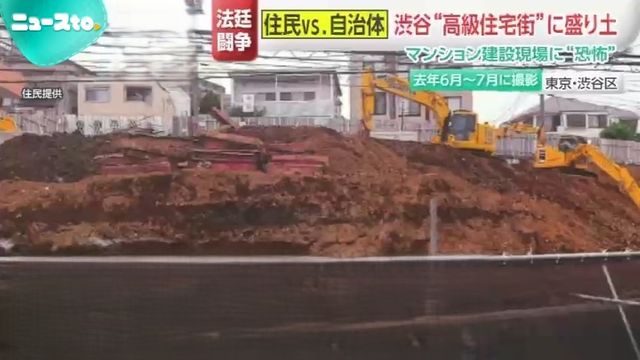
Residents of a wealthy Shibuya Ward neighborhood are in a court fight with the ward government over a huge mound of soil that appeared on a demolition site, after the ward argued the pile falls outside its regulations.
Demolition began in October 2024 on a 2,400-square-meter lot in Shibuya, Tokyo. A three-story apartment building with one basement level is scheduled for completion in 2029, according to the site's status as of October 21, 2026.
More than half a year later, residents found a mound rising two to three stories high, with a height difference of about 10 meters. It was initially uncovered, without even blue tarps.
“I was surprised — I thought a ski resort had been built. There was no retaining wall or anything then, so when it rained I worried it could collapse at any time.”a local resident, resident
A law born from the Atami disaster
The key question is the soil-mound regulation law, enacted after a 2021 landslide in Atami, Shizuoka Prefecture. It designates areas where mounds could cause damage as regulated zones, where a governor's permission is required to build one.
The operator had not applied for permission by the time the mound became conspicuous. Yomiuri TV asked the Shibuya Ward Office, which licenses and supervises the operator's construction work, whether the mound violated the law.
The ward has argued the mound is not subject to the regulations. Residents demanded the work stop, and the dispute went to court.
Lower court orders a halt
The Tokyo District Court found the mound dangerous and issued an order to stop the work. Shibuya Ward did not accept the ruling, and the case moved to the Tokyo High Court.
Lawyer Masaki Kamei, commenting on the high court's decision, described the turn of events as an ironic development.