
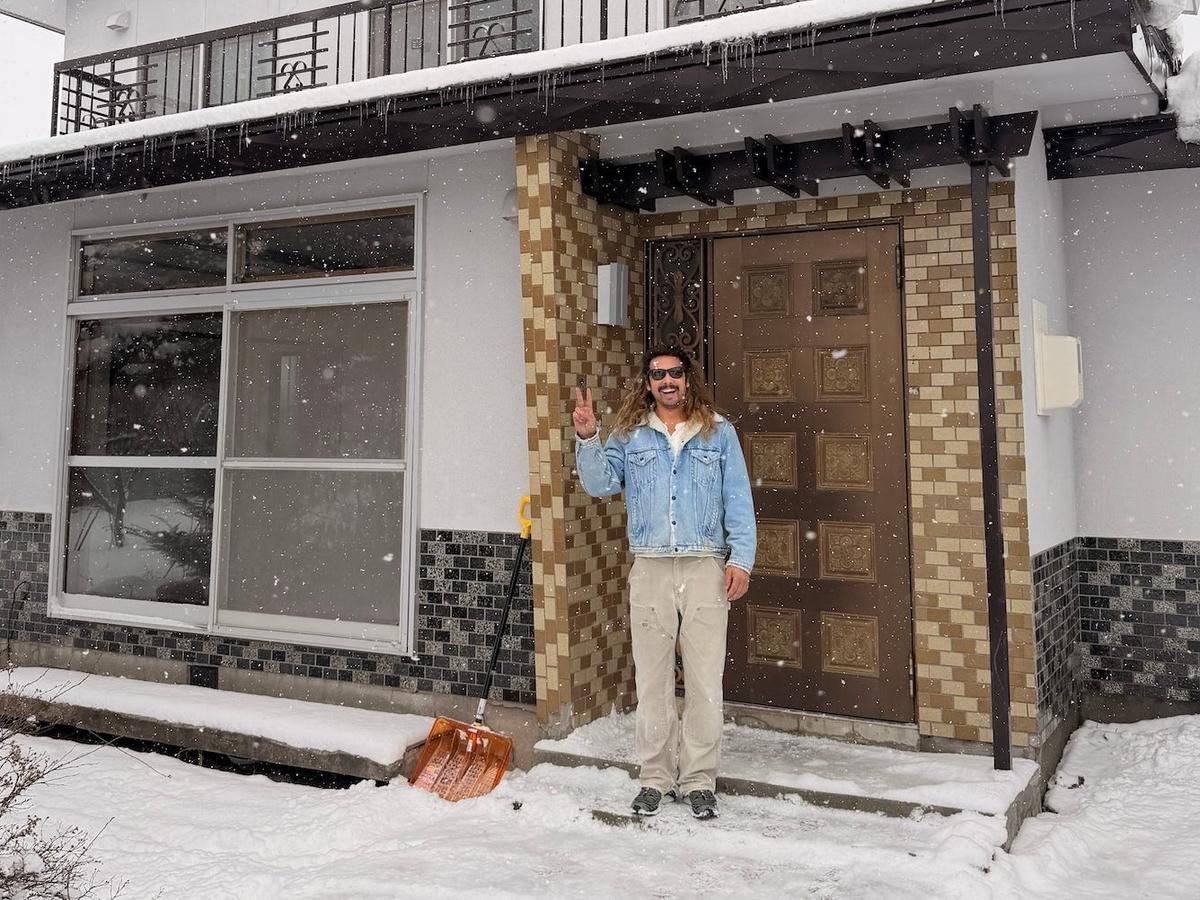
A professional gambler who left Modesto, California, for a rural house in Hokkaido says the cheap empty homes that draw foreigners to Japan are a poor investment, even though the move made sense for him.
Keito Swan, 37, was born in Japan and lived in Sasebo, Nagasaki Prefecture, until he was 7. His father is white and his mother is Japanese.
He spent most of his life in Seattle and about seven years in California. He had considered moving to Japan before, but held back.
"It's cheap enough just to go on vacation," he said. "Is there any point in carrying the burden of owning a house when I'm not even going to live there?"
After two years traveling and driving the Pan-American Highway, he decided the United States did not suit him. He considered buying in Argentina.
Japan won because he already held Japanese nationality, spoke the language and knew the culture. Cost of living and quality of life were the other big reasons.
He paid $115,000 (about ¥18.2 million) for the property about a year and a half ago. The house was old, covered in mold and close to collapse.
A full renovation cost another $65,000 (about ¥10.3 million). A family friend who runs a construction company handled all of it.
The house sits at the foot of Japan's largest national park, with perhaps six ski resorts within an hour. Rice fields surround it.
It is 15 minutes from an airport with direct flights to Tokyo and 30 minutes from Hokkaido's second-largest city. Winter temperatures fall to minus 30 degrees Celsius, and snow piles several meters deep.
"It's not for everyone, but for an outdoor type like me who loves winter sports, there's no better environment," he said.
Cheaper than California, but not cheap
Swan says life in Japan is far more fun than his time in Modesto, a farming area known as the world's almond capital. Yosemite and Lake Tahoe were both two hours away, San Francisco an hour and 40 minutes.
He once rented an in-law suite in Sausalito, just outside San Francisco, for $3,200 a month (about ¥510,000). The sea was visible, he concedes.
That rent equals three times what he now spends each month on housing and all other living costs in Japan combined.
Utilities run about the same as in the US, or a little less, except in winter. Gas heaters and higher electricity use then triple the bill.
He pays about $60 a month for electricity, $35 in property tax and $30 for health insurance, which covers dental and eye care.
He often eats at a local bar that cooks from scratch rather than frying everything. Dinner usually costs ¥1,200, and the ingredients are all local.
Outside winter, his monthly living costs come to a little over $1,000 (about ¥160,000).
The akiya math
Swan did not buy a wrecked rural house for $20,000 (about ¥3.16 million). He bought a somewhat run-down house in the Japanese countryside for $115,000.
Anyone who has seen on social media how cheap Japanese houses are may find $180,000 (about ¥28.4 million) all-in a large sum. That is precisely why he paid a premium, he says.
He argues that buying in rural Japan makes sense mainly for people who are retired, have some freedom and are not buying a collapsing ruin.
He is often accused of pulling up the ladder behind him. "But this is a terrible investment," he said.
His example: buy a house for $50,000 (about ¥7.9 million), then spend perhaps another $50,000 on repairs. Put that $100,000 (about ¥15.8 million) in the stock market instead, he says.
Rent an Airbnb in Japan for three months a year with the returns, and you would be far ahead without the burden of ownership.
Japanese houses are not built as investments, he says. The craftsmanship is excellent, but the land beneath the house is what holds value, and only in areas popular enough to keep it.
He lives in a district where land prices are rising fast, and stresses that he researched thoroughly beforehand.
Most of these empty houses, known as akiya, sit in places where depopulation is pushing land prices down.
"If I had no money, couldn't speak the language and had no nationality that let me stay here, I would never have chosen this path," he said.
He encourages people to take a big risk and move somewhere they can find their own version of the American dream. "But Japan is not that kind of country," he said.