
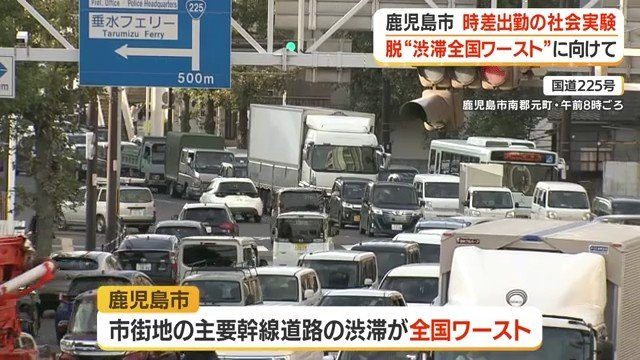
Kagoshima, whose city-center congestion ranks worst in Japan, began a staggered-commuting trial on November 9 to spread out the morning rush, with results due in March 2027.
The experiment runs for 10 days through November 20, excluding weekends. Participants who registered in advance are asked to commute to work or school before 7:30 a.m. or after 8:30 a.m.
Those hours bracket the period when the city's roads are busiest. The aim is to thin traffic during the peak.
A ¥41 Billion Annual Loss
The Ministry of Land, Infrastructure, Transport and Tourism publishes a congestion index for major arterial roads in city centers. Kagoshima ranks last nationwide on that measure.
The city estimates that delays caused by congestion cost logistics and tourism about ¥41 billion a year.
Even at the junction of National Route 225 at the Murasakibaru housing complex entrance, where there are multiple lanes, commuting cars are backed up, an FNN Prime Online reporter said from the scene.
The city launched the trial to look for a way into the problem.
Fewer Sign-Ups Than Needed
The city says it needs 4,000 participants to cut peak-hour traffic volume by 10%. As of November 8, about 3,000 people had registered, short of the target.
“I want people to feel that their usual commute is even a few minutes shorter. If it becomes a step, a motivation, for staggered work hours to take hold at companies, that would be good.”Takashi Nakae, manager of the Kagoshima City road improvement division, 鹿児島市街路整備課長
Nakae said he hopes even one more person from the private sector signs up now that the experiment has started. The city is continuing to call for participants.
The city will compile its findings from the data and questionnaires collected during the trial and publish them in March 2027.