
Japan's child sex-abuse prevention law takes effect on Dec 25, requiring schools and licensed nurseries to screen staff for sex-crime records, but volunteers and many small operators sit outside the mandatory check, the Nishinippon Shimbun reported.
The law, formally the Act on Prevention of Sexual Violence against Children, passed in June 2024. Calls for legislation grew after a 2020 babysitter indecency case and a series of teacher voyeurism incidents.
Police recorded more than 5,000 cases a year of sexual crimes against children in recent years, counting nonconsensual intercourse and nonconsensual indecency.
Who must check
About 126,000 sites nationwide must run the checks, including elementary, junior high and high schools, licensed nurseries and children's homes. Their roughly 2.8 million workers are covered, according to the Children and Families Agency.
Unlicensed nurseries, cram schools and after-school clubs may apply for state certification if they meet the standards. Screening is optional for them.
The scheme is known as the Japanese version of DBS, after Britain's Disclosure and Barring Service. Employers ask the Justice Ministry, through the agency, for a worker's sex-crime record.
Covered offenses include nonconsensual intercourse, nonconsensual indecency, voyeurism and groping. Sex crimes against adults are included too. Records reach back 20 years from the end of a prison sentence, or 10 years for a fine.
How the checks work
For new hires and staff being reassigned, the check runs between the job offer and the start of work. Until it clears, the worker should not be alone with a child as a rule.
Staff already employed must be checked within three years of the law taking effect. If a record turns up, the agency notifies the worker first.
The employer is told only if the worker does not withdraw the offer or request a transfer. The employer must then move the worker away from direct contact with children.
Operators must also define and circulate "inappropriate acts" that could lead to abuse. Examples include private messaging with a child on social media and photographing children outside work duties.
Meeting a child alone privately and unnecessary physical contact are also listed. Each workplace is to discuss the list so staff are not overly constrained, since what counts varies with a child's age and characteristics.
Operators must watch for changes in children through daily observation, interviews and questionnaires. They must set reporting rules and appoint a counselor as a contact point.
Staff must take training combining classroom study and practical exercises, and work rules must be updated. Operators that fail to act face penalties up to loss of their license.
Questions from the floor
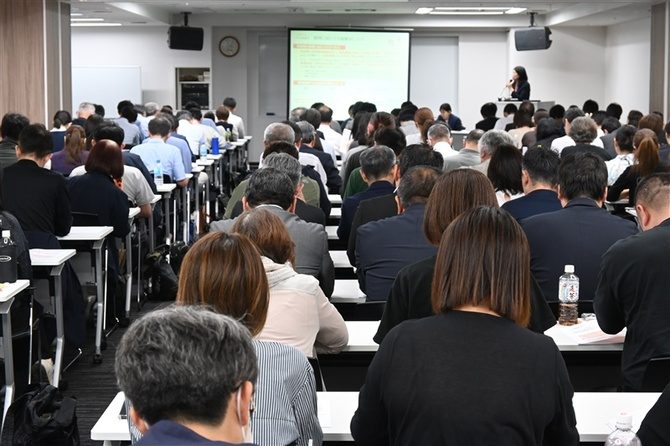
The agency held briefing sessions for operators, including the only one in Kyushu, in Fukuoka City in October. About 150 operators from across the region attended and pressed Keisuke Harazawa, an agency assistant counselor, with questions.
One asked who screens instructors when a school outsources its swimming lessons to a private sports club. The school, as the body running the program, must check outside instructors, the agency said. If the school only lends its pool, the club checks.
Another asked about kindergarten bus drivers. They are covered when the work meets three tests: control, continuity and seclusion. A driver who regularly carries children without another staff member aboard qualifies.
Volunteers and short-term spot workers must also be checked, whatever their contract type or length, the agency said. Repeat checks are unnecessary if the operator has written confirmation that the person may work again within six months.
Operators scramble
With less than two months to go, workplaces are rushing to prepare. A 55-year-old woman who heads a licensed nursery in Kumamoto City said the tasks are piling up.
“It is an important system so we will make it in time, but outside lecturers are involved as well as our own staff, so I worry whether the paperwork will go smoothly.”the nursery head, Kumamoto City
The checks require each worker to register personal information first. A 58-year-old woman who heads a licensed nursery in Saga City said staff worry about how that data is managed, given the attention to unauthorized access and leaks.
“It is hard to win their understanding.”the Saga City nursery head
A 40-year-old housewife in Fukuoka City, who has a 1-year-old daughter, called the system meaningful for protecting children and raising awareness among those who work with them.
“Many operators are optional rather than mandatory, so I am also anxious about whether it can really prevent sexual crime.”the Fukuoka City mother
Operators that take part receive a Komamorou Mark to display on business cards and advertising. There are two versions, one for schools and licensed nurseries and one for certified private operators, which parents may use when choosing lessons or a nursery.