
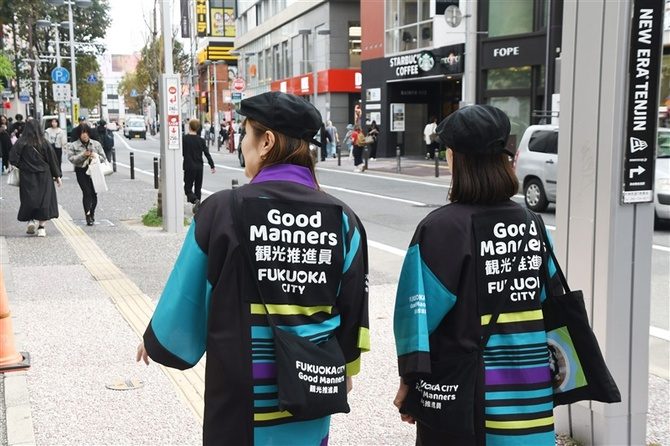
Foreign visitors brought Fukuoka record spending and filled its Nakasu food stalls, but some residents say the crowds leave trash in the streets, a tension the city is trying to ease with multilingual patrols.
At the Nakasu yatai stall Hakata Akanosuke, foreign customers pack in every night. Owner Koshiro Ueaka, 35, said about 80% of his customers are inbound tourists — visitors from abroad.
A male employee in his 20s said basic Korean, gestures and Google Translate get him through service. The Korean phrases ring out at the stall entrance: "Eoseo oseyo" for welcome, "myeot myeong-iseyo" for how many.
When Ueaka began working at another yatai more than a decade ago, visitors from abroad made up less than 20% of customers. They overtook Japanese customers before 2020, the year the coronavirus spread.
Now Koreans account for 40%, Chinese-speaking customers 30%, and visitors from Europe, the US and Southeast Asia 20%. Some come every week from overseas. Local customers make up less than 5%.
“Yatai cannot survive without inbound visitors.”Koshiro Ueaka, owner of the Nakasu yatai Hakata Akanosuke
Foreign arrivals through Fukuoka Airport and Hakata Port reached 4.33 million in 2025, up 60% on 2019, before the pandemic, according to the city. Credit card spending by foreign tourists in the city rose 20% on the previous year.
Garbage and crowds draw complaints
Not everyone welcomes the influx. A 56-year-old woman who runs a shop in the Tenjin district said sales have risen, but the areas where foreigners line up are sometimes littered with cigarette butts and plastic bottles.
In a prefectural survey at the end of 2025, more than 70% of residents said the number of tourists was "high" or "somewhat high." A combined 67% said they "very much want" or "are fine with" inbound visitors.
Another 27% said they "do not really want" or "do not want" them to come. Most inbound visitors to the prefecture stay in Fukuoka City.
The city's tourism industry division calls harmony with residents' daily lives important. It has assigned 10 "good manners tourism promoters" who speak English, Chinese and Korean.
Since October 1 they have patrolled the Tenjin and Hakata districts, urging people not to smoke while walking or sit down in the streets.
The findings were reported by the Nishinippon Shimbun.