
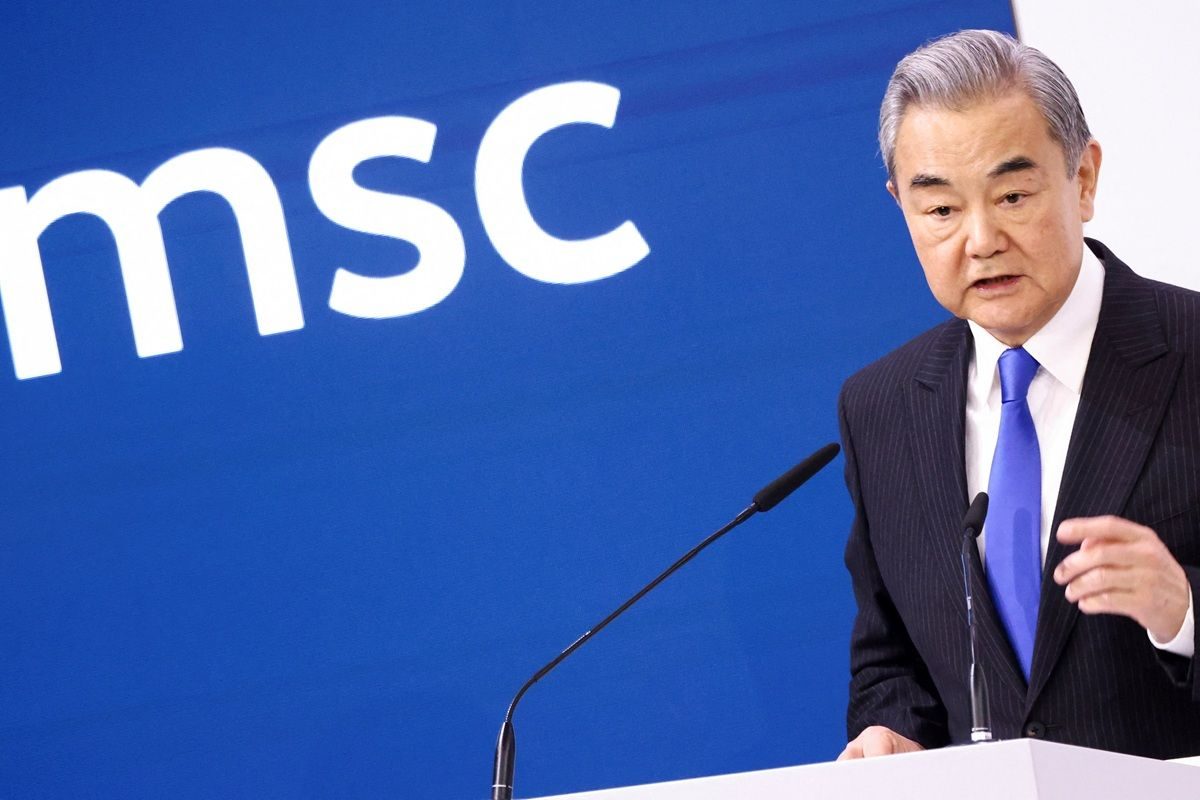
Wang Yi, China's foreign minister, used a Munich security conference stage to accuse Japan of reviving militarism and warned it would destroy itself, a performance aimed less at the diplomats in the room than at an audience at home.
The speech, delivered on February 14 at the Munich Security Conference, drew Foreign Minister Toshimitsu Motegi and Defense Minister Shinjiro Koizumi from Japan. JBpress translated it in full.
Wang began by praising China's diplomacy, citing its mediation of the Thailand-Cambodia conflict. He then turned to Japan and did not stop.
The accusation
Wang said Japan's sitting prime minister had stated in public that Japan might invoke the right of collective self-defense over the Taiwan Strait. He called it the first such remark by a Japanese prime minister in the 80 years since the war.
“This is a wild statement issued publicly by a Japanese prime minister for the first time in 80 years. It directly challenges China's national sovereignty.”Wang Yi, Chinese foreign minister
He said the remark violated the postwar international order under which Taiwan was returned to China, and broke Japan's political commitments to Beijing.
Wang compared Japan with Germany, saying Germany had fully settled accounts with fascism and banned the promotion of Nazism after the war.
Japan, he said, still enshrines Class-A war criminals at a shrine that politicians visit constantly. He called this the root of every problem.
He said Japan had launched its invasion of China and attacked Pearl Harbor in the name of a survival-threatening situation, and warned against repeating that path.
“If it returns to the road it once took, that is the road to self-destruction. If it gambles again, defeat will come sooner and be more miserable.”Wang Yi, Chinese foreign minister
A proxy for Xi
In Zhongnanhai, the compound that houses China's leadership, a saying circulates: Wang's mouth is Xi's mouth, Wang's eyes are Xi's eyes, Wang's ears are Xi's ears.
Wang is the only minister remaining from the 26 appointed when Xi's administration began in March 2013. JBpress reads the outburst as a measure of Xi Jinping's anger.
The anger dates to November 7, when Prime Minister Sanae Takaichi linked a Taiwan contingency to a survival-threatening situation in the Diet. China has been angry since.
Some commentators in Japan argued the anger would subside if Takaichi's Liberal Democratic Party won the election. More than a week after that victory, Wang spoke in front of the world's foreign and defense chiefs.
Tokyo's reply
Japan had largely watched and waited, on the reasoning of a Foreign Ministry official that the world understands China's abnormality and should not take it on directly.
The ministry answered on February 15 with a statement on X in English and Japanese, titled "On inappropriate remarks by a Chinese participant at the Munich Security Conference."
It said Motegi had rebutted the false content in a later session and that Japan had lodged a strict protest through diplomatic channels.
“Some countries have for many years continued to expand their military forces opaquely and have persistently strengthened attempts to change the status quo unilaterally by force or coercion. Japan opposes such moves and keeps its distance.”Japan's Foreign Ministry, statement on X
The statement said Japan's defense buildup responds to a worsening security environment and targets no specific third country. It said Tokyo's position that the Taiwan issue should be resolved peacefully through dialogue is unchanged.
It closed by saying communication matters precisely because Japan and China have outstanding issues, and that Japan is open to dialogue and will respond calmly.
What comes next
JBpress argues ties may worsen after the LDP's landslide, because Takaichi's policies become easier to carry out. At a February 9 press conference she named three priorities: responsible active fiscal policy, a fundamental strengthening of security policy, and stronger government intelligence.
The second and third amount to countermeasures against the Chinese threat, the outlet writes: more defense spending, revision of the three security documents, a review of the three non-nuclear principles, an anti-espionage law, a national intelligence agency, cooperation with Taiwan and constitutional revision.
As those policies advance, China is certain to press further with what the outlet calls wolf-warrior diplomacy. Tokyo should conduct diplomacy on the premise that relations will not improve, JBpress writes.