
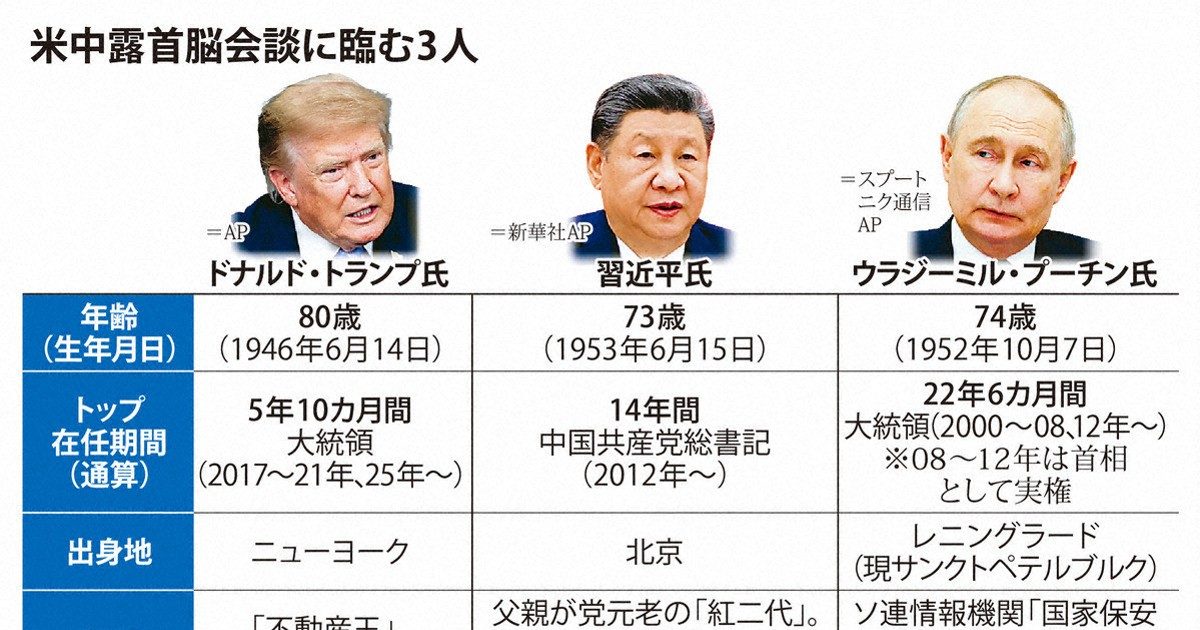
President Donald Trump, President Xi Jinping of China and President Vladimir Putin of Russia will meet in Shenzhen on the afternoon of the 19th, the first three-way summit of US, Chinese and Russian leaders in history, with nuclear disarmament, Iran and Ukraine on the agenda and a joint statement under negotiation, the Mainichi Shimbun reported.
According to the Russian side, the three governments are working toward issuing a joint statement after the meeting.
The Asia-Pacific Economic Cooperation (APEC) leaders' meeting opened in Shenzhen on the 18th for a two-day run. Trump, Xi, Putin and Prime Minister Sanae Takaichi are among the participants. Free trade and artificial intelligence are on the agenda.
Xi and Putin meet first
Ahead of the three-way summit, Xi held talks with Putin on the 18th. According to the state-run Xinhua news agency, Xi said China and Russia should shoulder the responsibilities and roles of major countries. He said the two should advance a multipolar world and the democratization of international relations. Putin called for stronger cooperation and exchanges with China.
Xi met Trump personally at the airport when he arrived in Shenzhen, staging an exceptionally warm reception. The gesture carried the meaning of a return courtesy for Trump greeting Xi in person during Xi's visit to the United States in September.
Shared wartime history invoked
The three leaders are projecting an atmosphere of friendship. Their calculations and positions on the summit's agenda differ, and how far the discussions will go is not clear.
Trump has shown eagerness to build a new framework for nuclear disarmament and to discuss the Iran nuclear issue. China, which holds fewer warheads than the United States and Russia, is reluctant to pursue disarmament or arms control at this point. A US military campaign against Iran that leaves Washington drained also suits Beijing and Moscow in some respects. Whether the three will hold substantive talks on Iran, with which China and Russia have close ties, is uncertain.
China and Russia have put the question of historical understanding at the front of their messaging.
“Historically, the three countries won the world anti-fascist war (World War II) together.”Mao Ning, spokeswoman for China's Foreign Ministry, speaking on the 16th
Yuri Ushakov, the Russian president's aide for foreign affairs, said the three countries are ready to hold useful and meaningful discussions. He said they would start from the highly constructive moments of their cooperation during World War II.
The intent is visible: Beijing and Moscow want to stress that all three nations were victors in the war and draw Trump into their narrative. Ukraine, which the US side had initially said would not be on the agenda, is now likely to be discussed.
Fears of a new Yalta
Some voices warn that the meeting amounts to a repeat of the Yalta Conference. At that meeting, late in World War II, the leaders of the United States, Britain and the Soviet Union discussed the shape of the postwar international order.
Ukraine and Taiwan are wary of major powers cutting deals over their heads. US allies including Japan, South Korea and European countries worry that Trump will be drawn in by China and Russia.
The Yalta Conference had many shared interests behind it. This meeting has few issues on which the calculations of Washington, Beijing and Moscow align. It may end up largely symbolic, aimed at messaging at home and abroad.
APEC tests AI rules and free trade
Attention at APEC is on whether the rapid spread of AI can generate momentum for international rules. Protectionism is strengthening worldwide, including under the Trump administration's high tariffs. How far a joint declaration can commit to free trade is another focus.