
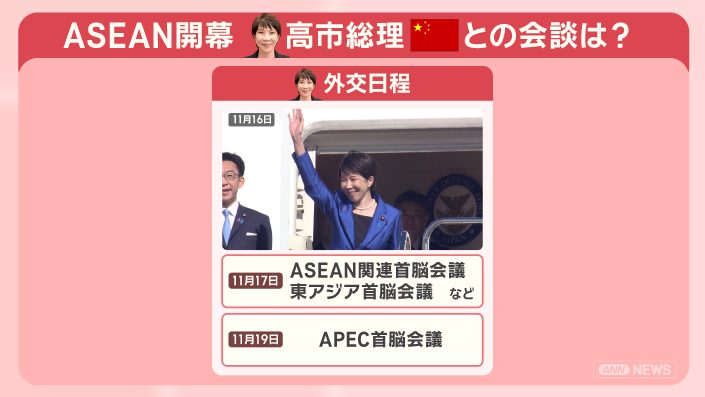
Prime Minister Takaichi is attending the ASEAN and APEC summits this week, but a year after her remark on a Taiwan contingency, Japan and China have arranged no leaders' meeting at either gathering.
Takaichi attended ASEAN-related summit meetings and the East Asia Summit on November 17. She moves to Shenzhen, China, on November 18 and attends the APEC leaders' meeting on November 19.
China appears to be avoiding Japan. Takaichi arrived in Manila on the evening of November 16, but Premier Li Qiang had already left for home that afternoon. The two did not make contact at ASEAN.
A summit at APEC looks unlikely
A Japan-China summit is also unlikely at APEC. According to the two governments, a meeting was arranged but is now expected to be shelved.
Government officials said coordination had gone badly since early November. Tokyo is weighing fallback options, including a brief contact on the sidelines.
A summit did take place at the previous APEC, held in October 2025. Takaichi and President Xi Jinping talked for about 30 minutes.
The two leaders confirmed they would advance the "strategically mutually beneficial relationship" and build a "constructive and stable" one.
Before that meeting, however, Takaichi posted on X that she had greeted Xi in a waiting room and had also greeted Taiwan's Lin Hsin-yi, a senior adviser to the island's presidential office.
“Posting photos of contact with the Taiwan side on social media gave the Chinese side a strong sense of discomfort toward Prime Minister Takaichi.”Chijiiwa, head of the political desk's Kantei team at TV Asahi, TV Asahi political desk
Rare earths and a collapse in tourists
A year after the Taiwan remark, the effects are still running through both economies. Japanese companies in China are disappearing.
In 2024, 13,034 Japanese firms had bases in China. By June 2026 the number had fallen 22.4 percent to 10,118, the lowest since the survey began in 2010.
Worsening ties and other risks that cannot be foreseen are seen as the cause.
Chinese students of Japanese are affected too. A man teaching Japanese in Shanghai said Beijing instructed schools in 2025 to hold back on study trips to Japan.
From September 2026, schools were told to use Chinese textbooks. Japanese materials can no longer be used, and Chinese authorities came to inspect schools, he said.
“I don't know whether this measure applies only to Japan or to other countries too, but I think it is only Japan.”a Japanese teacher in Shanghai, Japanese teacher
Rare earth curbs hit manufacturers
China has tightened restrictions on rare earths. Yttrium is used in semiconductor manufacturing equipment and medical devices, and China holds most of the world's production and refining.
Exports to Japan came to 887 tons from January to September 2025, down about 98 percent on the year before. In 2026 the figure stands at 18 tons.
More than 90 percent of Japanese companies report difficulty obtaining rare earths. Deliveries are delayed and production has stopped. Procurement costs are up by more than 20 percent on average.
A Japanese magnet maker produces samarium-cobalt magnets, used from appliance heaters to car motors. It cannot get the samarium they require.
The company is working from stock, but output has fallen to under 20 percent of pre-restriction levels.
“The performance is a little inferior, but we are asking customers to switch to a different magnet.”the president of Himeji Denshi, Himeji Denshi
A Japanese tool maker needs tungsten for the strength of tools used in mold processing. Tungsten prices have risen tenfold since the restrictions, and supply is hard to secure.
The industry is accelerating domestic recycling in response.
“This is a situation we have never seen before, and we feel a considerable sense of crisis.”a tool maker executive, tool maker
“Lowering our dependence on China will take time. If the restrictions tighten, the supply chain will be split. That remark by Prime Minister Takaichi has put industry in a very difficult position.”an automaker executive, automaker
Flights and tourists
China is also pressing Japan's tourism industry. Beijing asked Chinese travel agencies to cut the number of travelers to Japan by more than 60 percent.
It instructed Chinese airlines to cap the total number of flights to Japan. About 7.5 million Chinese visitors came to Japan by September 2025. In 2026 the figure is 3.34 million, less than half.
Scheduled flights between the two countries at major Japanese airports numbered about 1,300 a week in 2025. In 2026 they are down about 53 percent, to roughly 600 a week.
A company offering services to inbound visitors, including a sushi bus, says no group bookings from China are coming in at all. Its inbound-related sales are down about 20 percent overall.
“We get many inquiries from China, but nothing is settled because of the state of Japan-China relations. Businesses related to food are hit hard.”Yano, the company's president, inbound tour operator
At Hankyu Hanshin Department Stores, Chinese tourists fell about 30 percent in fiscal 2026.
“Fewer flights limit visits to the Kansai region. A drop in customers from China cannot be helped.”Yamaguchi, the company's president, Hankyu Hanshin Department Stores
China's three biggest airlines also expect losses. For the first half of 2026, their combined net loss is projected at about 194.2 billion yen.
Ke Long, a senior research fellow at the Tokyo Foundation who follows Japan-China relations, sees high fuel costs and deep cuts to the profitable Japan routes as the cause.
“China is trying to build a story that Japan has lost a great deal because Chinese tourists no longer visit. But China has also taken a certain economic damage from this series of measures.”a Japanese government official stationed in China, Japanese government official
How past breakdowns were repaired
Past breakdowns were repaired through quiet channels. In September 2012, the Japanese government bought the Senkaku Islands from a private owner and brought them under state control.
Anti-Japan demonstrations broke out across China, and mobs attacked Japanese companies.
In July 2014, former Prime Minister Yasuo Fukuda visited China in secret and met Xi. He carried the intentions of then Prime Minister Shinzo Abe, opening negotiations toward a summit.
Fukuda arranged the meeting through his own route, without going through the Foreign Ministry. A summit followed in November 2014, when Abe and Xi met.
The two shook hands with grim faces, but the meeting was a step toward repairing ties.
An agreement reached beforehand noted that the two sides "recognize that different views exist" on the Senkaku Islands because of tensions in recent years. It left room for interpretation without changing either position.
Channels to Beijing are thinning
Japan's channels to the Chinese side are narrowing. Fukuda, who had his own line to Beijing, died in October. Former Lower House Speaker Yohei Kono, who worked to improve ties, died in June.
The government is still trying to make contact. In July, Foreign Minister Toshimitsu Motegi said he had spoken with Chinese Foreign Minister Wang Yi at an ASEAN foreign ministers' meeting. China declined to confirm any contact.
In September, former Foreign Minister Takeshi Iwaya met Wang and Vice Premier He Lifeng in succession. The Chinese side pressed him to correct Takaichi's remark.
“Compared with 2014, the diplomatic route is thinner and the back-channel has been cut. There is no environment in which Japan and China can speak frankly. A pipe means nothing unless it connects to the prime minister of the day.”Chijiiwa, head of the political desk's Kantei team at TV Asahi, TV Asahi political desk