
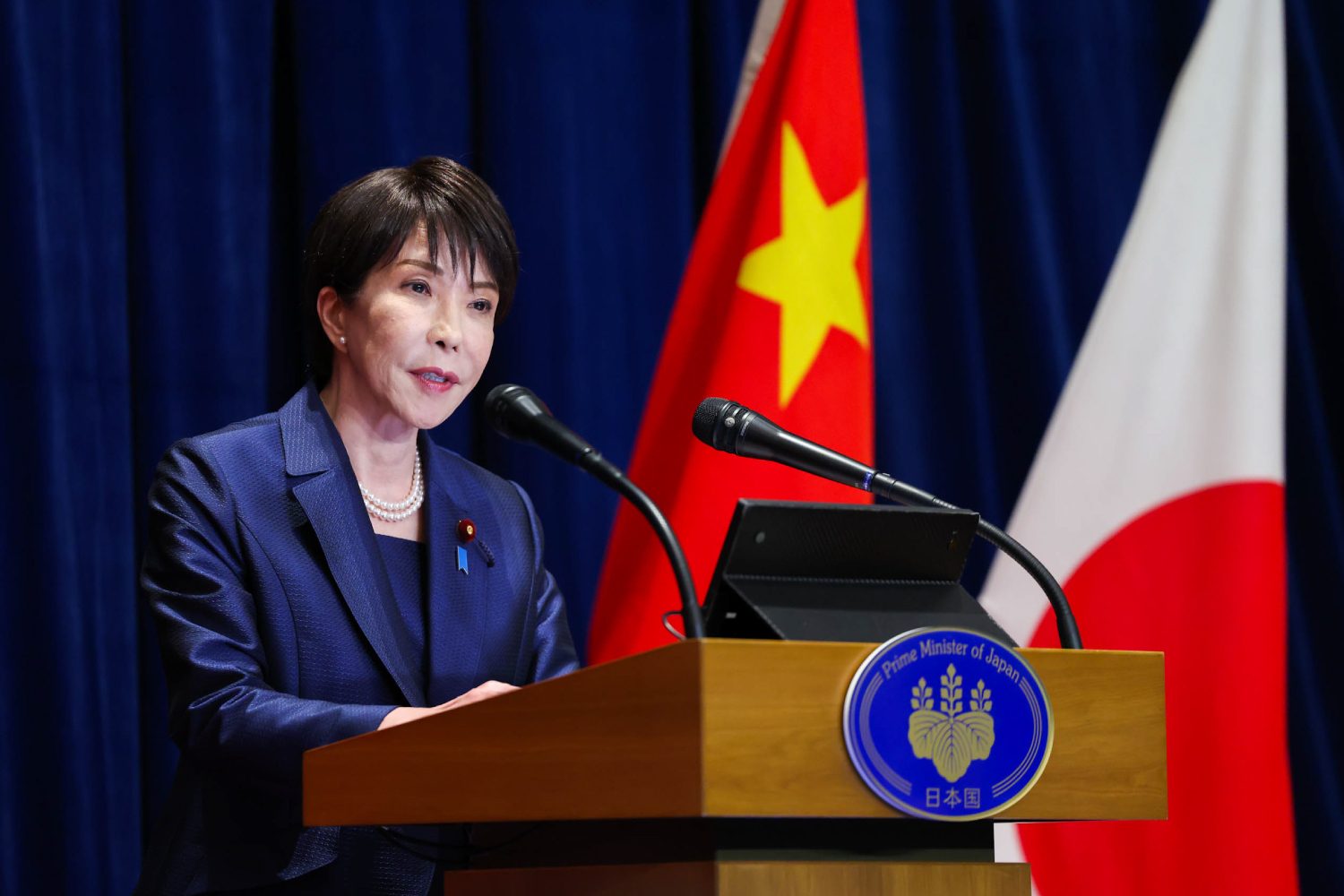
Prime Minister Sanae Takaichi's run of summit diplomacy ended last week without a meeting with Chinese President Xi Jinping and without progress on a Japanese reporter held in Russia, leaving Tokyo with few levers as Washington edges toward Beijing and Moscow.
The stretch took in ASEAN-related leaders' meetings in Manila and the APEC summit in Shenzhen. Takaichi also met Russian President Vladimir Putin there, according to reports.
A cold reception in Shenzhen
Japanese media had watched closely for how Xi, whose country hosted APEC, would treat Takaichi amid souring ties. There was no welcome ceremony at the airport, only a greeting from the Foreign Ministry's protocol ambassador.
The two leaders shook hands at the summit and at a banquet. Xi did not answer when Takaichi spoke to him. In the leaders' group photo, she was placed at the edge of the back row.
Beijing has branded Japan a "new militarism" over Takaichi's remarks on a Taiwan contingency. Former Ambassador to China Hideo Tarumi, while condemning the discourtesy, said Japan needs "a long-term strategy that does not swing on every Chinese move," the Sankei Shimbun reported on November 20.
No channel to Beijing
The harder problem is that Takaichi has no line of dialogue with Beijing, not merely no quick fix. When former Foreign Minister Takeshi Iwaya visited China in September, Beijing received him cordially. There is no sign Takaichi entrusted him with a letter or message for Xi.
The figures who once carried those channels are gone. Former Prime Minister Yasuo Fukuda and former Lower House Speaker Yohei Kono, both with wide Chinese networks, have died. Former LDP Secretary-General Toshihiro Nikai has retired from politics, and Komeito, long a bridge to China, has left the ruling coalition.
Iwaya, who had thin ties to China until now, lacks the standing for the role. Former Prime Minister Shinzo Abe, whose Yasukuni visits chilled relations, handed back-channel talks to Nikai despite their poor personal chemistry.
Earlier still, in the 1960s and 1970s, Beijing refused to deal with Prime Minister Eisaku Sato's cabinet. Sato asked Tokyo Governor Ryokichi Minobe, a political opponent, to carry a letter to Premier Zhou Enlai in 1971, signed by LDP Secretary-General Masayoshi Ohira.
Kakuei Tanaka, who succeeded Sato and normalized ties with China, used Komeito and Soka Gakkai, then opposition groups friendly with Beijing, to clear the way.
At a news conference in Shenzhen, Takaichi said the four Japan-China documents, including the 1972 joint communique and the 1978 peace and friendship treaty, remain "the basis" of the relationship. She said Japan's position on Taiwan is as stated in the communique.
In that communique, Japan says it "understands and respects" Beijing's position that Taiwan is an inalienable part of China. Beijing has pressed for a reaffirmation of the four documents, which gives her signal its weight. With no back channel, Tokyo could not test the ground in advance and acted on its own judgment.
Russia: no answers on the reporter
The Putin meeting turned on the detention of a Hokkaido Shimbun reporter and on Japan Tobacco's Russian operations being placed under Russian government control. Takaichi mentioned the Putin talks only in her opening statement.
Asked about them, she said she had "taken time for a thorough exchange based on Japan's position." She did not say what was discussed, how Putin responded, or whether the reporter's release had advanced.
Some see little chance of winning the reporter's freedom without concessions such as partially lifting sanctions on Russia.
In her opening remarks she dwelt on the success of the Quad meeting of Japan, the US, India and Australia in Manila. Stressing only the wins while setting aside the bad news is hardly honest.
Trump's tilt toward Beijing and Moscow
The week also sharpened the question of distance between Takaichi and the Trump administration. A first three-way US-Russia-China summit was held, and Trump briefed Takaichi by phone afterward. No preparatory meeting with her was arranged.
The "peace declaration" issued after the summit strongly criticized the International Criminal Court, whose president is the Japanese judge Tomoko Akane. Takaichi has not said how she raised the unfounded criticism with Trump, given her emphasis on the rule of law.
In the same period, the UN General Assembly adopted a resolution condemning North Korea's human rights record. The US abstained, apparently reluctant to back a text calling for referral of the abuses to the ICC.
The abstention looks like a signal to North Korean leader Kim Jong Un, whom Trump has sought to meet. For Japan, which seeks US help on the abductions issue, asking Washington for cooperation no longer carries much weight.
At the three-way summit, Xi and Putin each called their countries victors of World War II who defeated fascism. Trump's response is not known. When Xi visited Washington earlier, Trump noted that the two countries fought as allies in the war, and Xi replied that the US and China fought Japanese militarism.
Where Japan goes from here
Experts broadly agree Japan should work more closely with middle-power countries. Which ones, and how, is far from easy. Few expect Japan to change the US alliance as the axis of its foreign policy.
Many worry that a Takaichi government leaning harder toward Trump will find itself in trouble. Her unabashed praise of Trump, telling him in February that "only you can bring peace and stability to the world," runs against a global drift toward arrangements that exclude Washington.
Richard Haass, who long led the US Council on Foreign Relations, said the Trump administration "does not look after friends and allies in order to get the deals it wants." Japan must decide whether to seek new partners or build up its own defense and autonomy, he said, calling it "a serious strategic choice," the Yomiuri Shimbun reported on November 21.
Takaichi herself told the Diet in February that Japan must "take the wheel, think for itself and decide with a long-term view where it is headed." The week just past was a symbol of the old order changing, and the time to decide has come early.