
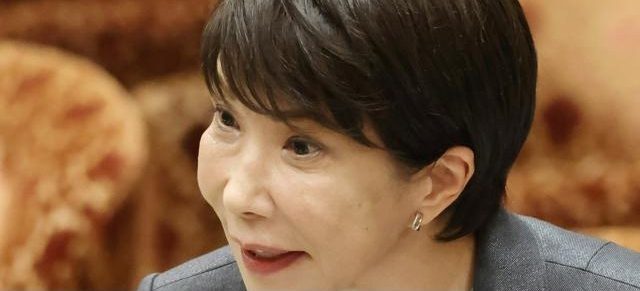
Prime Minister Sanae Takaichi said the income support payment that will accompany next April's consumption tax cut on food could reach more than 30% of current workers, opening the door to a wider pool of recipients than her earlier ¥20 million estimate implied.
Speaking at the Lower House Financial Affairs Committee on the 6th, Takaichi said her government would aim for "at least around 30%, comparable with other countries" as the share of the current workforce covered. She had previously put the figure at about 20 million people, based on estimates from similar programs abroad, and described the group as broadly those earning between ¥1 million and ¥3.5 million.
On the 6th she said the ¥3.5 million figure was not fixed. "We have not set ¥3.5 million as an amount; we are thinking somewhat more broadly," she said.
Komeito leader Mitsunari Okamoto told the committee the ¥20 million figure was too small, since it leaves out about 100 million people. "Thirty percent must not be the ceiling," he said, asking the government to design the scheme so that a wide range of workers can receive it. He also said a vote on the bill was hard to justify while the overall shape of the program remained unclear.
The committee session was Takaichi's first appearance before the panel at the opposition's request. She was scheduled to take questions for an hour.
G7 absence questioned
Okamoto also challenged Takaichi over her absence from an online meeting of Group of Seven leaders held on the night of October 2, asking whether it had been a serious failure. Takaichi said the decision had been made "on a comprehensive judgment" and did not elaborate on why she stayed away.
Okamoto argued that the meeting's topic, which he said concerned diesel fuel in the US and Europe, did not make it irrelevant to Japan, which faces energy scarcity. If Japan treated the subject as unrelated, he said, other countries could use the same logic to skip a G7 discussion of East Asian security.
Takaichi pointed to her past attendance at G7 meetings and her talks with European leaders. "With the free and open international order wavering, I am resolved to carry out a strong Japanese diplomacy," she said, adding that she intends to make good use of diplomatic opportunities. Okamoto replied that this did not explain the absence on October 2.
The consumption tax cut and the support payment are being debated together in the Lower House, with the ruling bloc aiming to clear the chamber on the 6th.