
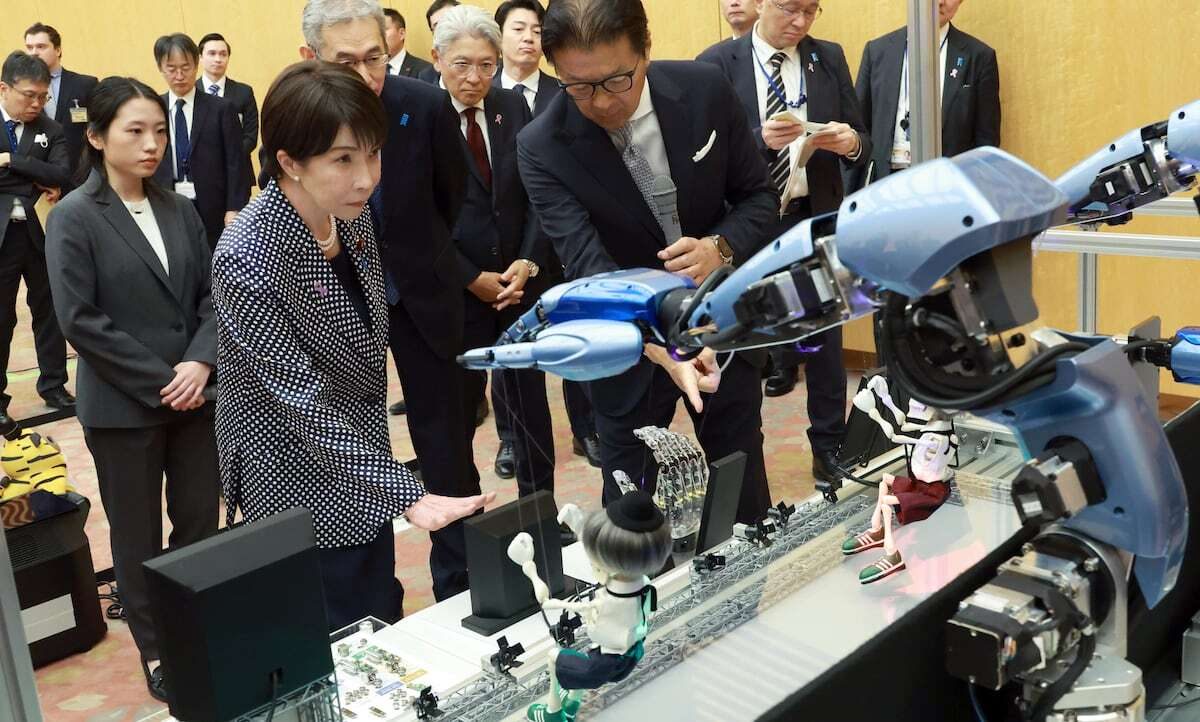
Prime Minister Sanae Takaichi will propose an "Asian common market" for advanced technologies such as AI and quantum computing at ASEAN-related summit meetings in Manila on the 17th, Sankei Shimbun reported, aiming to set Asia's tech standards before China does.
The proposal is expected to be written into a joint statement by AZEC — the Asia Zero Emission Community, a decarbonization framework Japan launched in 2023 under then-Prime Minister Fumio Kishida — as the "Bridge Asia" initiative. Leaders of 13 countries are due to take part: the 11 AZEC partners plus India and South Korea. Together they account for about 2.3 billion people, roughly 30% of the world's population.
Japan would join from the joint research and demonstration stage, helping Japanese companies win overseas markets. Government and ruling party officials confirmed the plan on the 15th.
17 strategic fields
The initiative covers the 17 strategic fields Takaichi has championed, including AI and digital technology, green and decarbonization technology, and quantum and advanced measurement. Companies and universities in Japan and AZEC countries would launch several international joint projects in fields expected to yield overseas markets.
The Japanese government would back the projects with subsidies over multiple years. The results would feed into rule-making and standardization in partner countries, and then into their national regulations.
Countering China's Digital Silk Road
China is drawing Asia's advanced infrastructure into its orbit through the Digital Silk Road, the digital and high-tech version of its Belt and Road economic bloc vision. Next-generation 5G networks and data infrastructure are already becoming entrenched, leaving critical information on policymaking and security in Chinese hands — a serious risk to national sovereignty.
Japan and its AZEC partners aim to establish trusted common standards in advanced technology and secure autonomy that does not depend on any single country. The plan is to raise partners' economic resilience and strengthen economic security, giving concrete form to the Free and Open Indo-Pacific (FOIP) vision Takaichi pursues.