
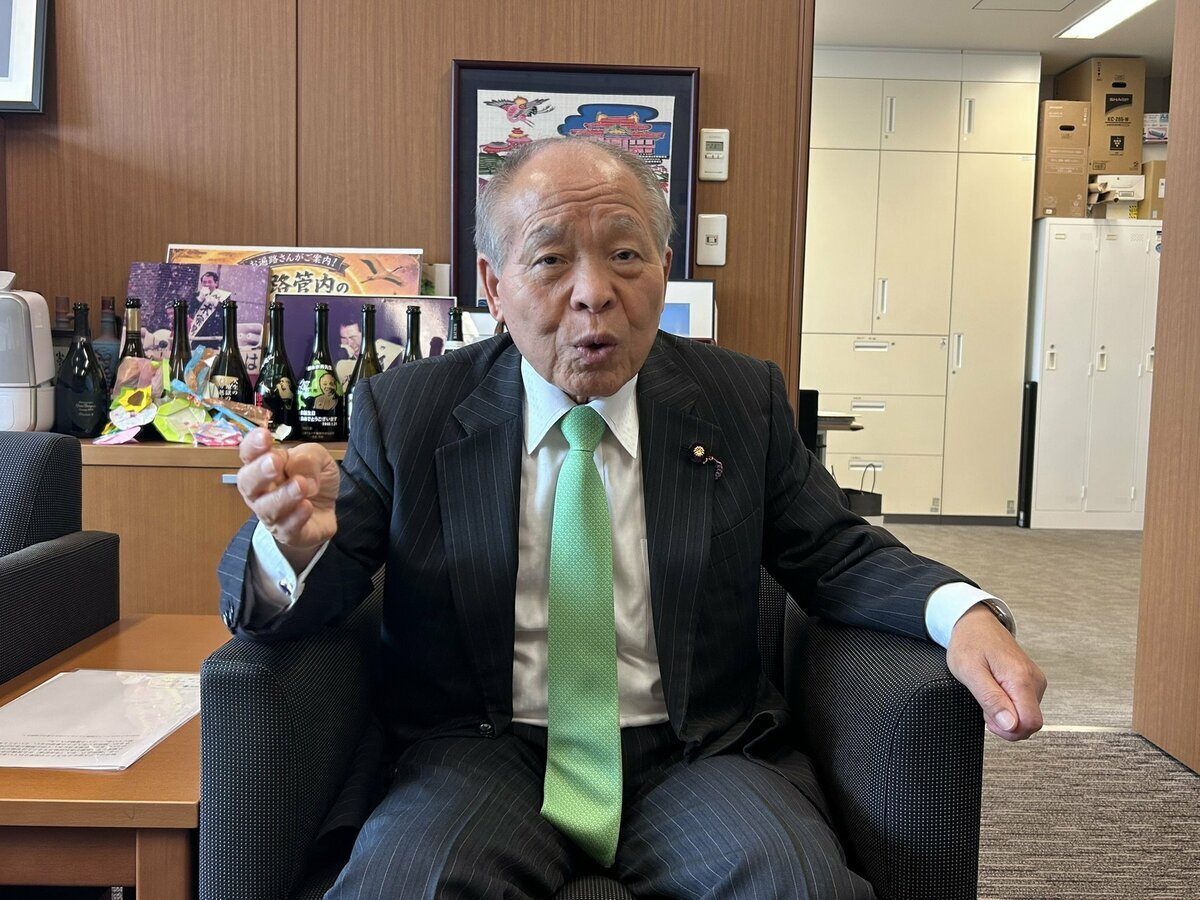
Veteran LDP lawmaker Muneo Suzuki, who says he has known the detained Hokkaido Shimbun reporter for more than a decade, argued that demanding the journalist's immediate release could harden Russia's position and prolong the case.
Russia's Federal Security Service, the FSB, announced on October 13 that it had detained a Japanese male reporter from the Hokkaido Shimbun's Yuzhno-Sakhalinsk bureau on suspicion of spying. The agency released footage of officers entering a hotel room and handcuffing him.
The reporter was detained the day before he was due to return to Japan at the end of his posting. The FSB says he was gathering information on Russia's defense capabilities for a Japanese intelligence agency.
Foreign Minister Toshimitsu Motegi met his Russian counterpart, Sergei Lavrov, on October 30 and called for the reporter's immediate release. Suzuki, a 78-year-old House of Councillors member known for his pro-Russia views, has been working through his own channels.
A reporter focused on ordinary life
Suzuki said he was stunned by the news. He described the reporter as mild in both appearance and character, and not the type to chase exclusives or push himself forward.
“He is a very gentle man, inside and out. I wondered whether they had the wrong person.”Muneo Suzuki, LDP lawmaker
The lawmaker said the reporter was delighted when his posting to Yuzhno-Sakhalinsk was decided, and that he took a strong interest in Japan-Russia relations. Suzuki doubts the reporter had any intent to collect military or defense information.
He suggested the reporter's interest lay in how ordinary people lived, photographing residents and asking about social conditions. Such reporting itself may have drawn the attention of the authorities, Suzuki said. Close ties with the Japanese consulate, which hosts staff seconded from various ministries and people from private companies, could also have been a factor, he added.
A request for humanitarian consideration
Suzuki went to the Russian Embassy at 3 p.m. on October 14, the day after the detention was announced, and asked Ambassador Nikolai Nozdrev for humanitarian consideration. Five days later, the embassy told him the reporter was in good health and eating, and had asked for nothing, including medicine.
On October 26, staff at the Japanese Embassy in Russia held a consular meeting with the reporter and announced he had no health problems. Suzuki said the same information had reached him seven days earlier, and that he shared it immediately with those involved.
He told the reporter's wife that her husband was well and that Russian authorities were passing on information properly. She stayed calm throughout, he said.
Suzuki said he chose the phrase "humanitarian consideration" deliberately. A demand to release him at once, he argued, risks Moscow digging in and complicating the case.
“Criticizing that as weak-kneed is the view of an amateur who knows nothing about intelligence.”Muneo Suzuki, LDP lawmaker
Whether to release the reporter is for the FSB to decide, Suzuki said. A Moscow court has ordered him held for two months, until December 12. With the investigation still under way and the details of the suspicion not yet clear, he argued, pressing the charge that the detention is unjust would itself look unjust from Russia's side.
He told Nozdrev that the reporter has a small child and that his family is worried. Suzuki said the ambassador understands that behind the phrase "humanitarian consideration" he is seeking release, and that years of trust between the two men mean his request has likely been shared within the Russian Foreign Ministry.
Even so, he said it is unknown how far the ministry could influence the FSB, even if it wanted to avoid a row with Japan.
A security service acting on its own
Some see the detention as retaliation for Japan's tightening of economic sanctions over Russia's invasion of Ukraine. Suzuki disagrees, saying he takes it as the result of the FSB acting on its own judgment in its domestic counterintelligence work.
He noted that Japan set up a national intelligence bureau this year, and said Russia's security apparatus is far more thoroughgoing. In his view, the FSB simply did its job.
Still, he acknowledged that Japan-Russia relations have deteriorated to what is described as their worst state since the war. Resolving the detention and improving ties are both urgent tasks for the Japanese government, he said.
A shoulder tap and a stalled handshake
Motegi and Lavrov met on October 30 for the first time in about five years, with Motegi seeking the reporter's release and peace in Ukraine. The two had also had brief contact at a dinner during the ASEAN foreign ministers' meeting in the Philippines in July. Motegi said they discussed bilateral relations and regional affairs; Lavrov said they only shook hands.
Suzuki said that dinner exposed a cultural gap. Motegi tapped Lavrov on the shoulder from behind while Lavrov was seated. Suzuki said Motegi meant it warmly, but in Russia a tap on the shoulder from behind means picking a fight. Foreign Ministry staff could have prevented it, he said.
Lavrov later told an interviewer that he had suddenly been touched on the shoulder from behind, and that Motegi returned to his seat after a handshake before he could stand. Suzuki said he is hopeful about the relationship between the two men, who both enjoy a drink and once got on well.
Signals from Putin
President Vladimir Putin has also sent repeated signals about repairing ties. In August he said Russia had built constructive relations with Japanese leaders including former Prime Minister Shinzo Abe, but that Japan's position had changed. Suzuki said the remark was clearly aimed at Prime Minister Sanae Takaichi, who considers herself Abe's heir.
Takaichi often says she understands the importance of Japan-Russia relations, Suzuki said. Russian cooperation is essential for Japan as it seeks a summit with North Korea to resolve the abduction issue, and he believes she is waiting for the right timing.
The APEC leaders' meeting is due to be held in China on the 18th and 19th of this month, and Putin will attend. Suzuki said the two sides should start by greeting each other and talking. "That is where Japan-Russia relations begin," he said.