
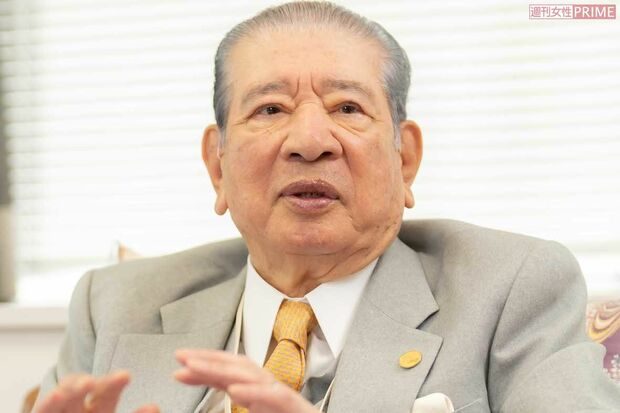
Yoshitaka Sasakawa, a former chairman of the Liberal Democratic Party's general council and a son of the late Ryoichi Sasakawa, has argued for cash handouts over a consumption tax cut in a new book, "Naiyu Gaikan: Nihon yo Doko e Yuku" (Aoshi-sha). He set out his views on the economy, the cabinet and the imperial family in an interview with Shukan Josei PRIME.
Sasakawa, who has been called the LDP's last don, drew on his experience as a company executive and a politician. The book, whose title translates as "Internal Troubles, External Threats: Where Is Japan Headed?", offers his prescriptions for problems at home and abroad.
His call for handouts rather than a tax cut puts him at odds with the fiscal debate inside the party as Prime Minister Sanae Takaichi's cabinet, one year after taking office, holds high approval ratings that have begun to look slightly less solid.
Farm minister's resignation
Sasakawa said the resignation of Agriculture, Forestry and Fisheries Minister Kazuo Yanagi, who faced criticism over remarks that he had cut budgets for municipalities that backed his rival candidates, was the right call. Yanagi lost his single-seat district in February's general election and returned through the proportional representation block, Sasakawa said, and probably made the remarks in frustration.
"Everyone makes mistakes," Sasakawa said. "What matters is how you face them. It is politicians themselves who decide whether to stay or go, so I think it was good that he made the decision himself."
He said Takaichi bears some responsibility for the appointment, since the prime minister holds the power to name ministers. She defended Yanagi at first, Sasakawa said, because having chosen him she had little choice but to back him, and the remarks under scrutiny predated his cabinet post. But with opposition pressure threatening to stall the Diet and hold up key bills, he said, the timing of the departure was right.
Yanagi was also one of the LDP lawmakers in the Abe faction caught up in the slush-funds scandal. Sasakawa said Takaichi's approach to appointing such lawmakers rests on the view that they have answered for it at the polls: they won because they had voters' confidence, and would have lost otherwise. He called that reasoning reasonable, and said that continuing to bar them after voters had passed judgment was like arguing that anyone with a criminal record should be excluded forever.
Imperial family
On the imperial family, Sasakawa said he supports allowing a woman to reign. The constitution calls for equality between men and women, he said, and the rule limiting the throne to men in the male line dates only from the Meiji era — before that, eight women had been emperor.
He was more cautious about an emperor descended from the imperial family through the female line, a case he said has no precedent. "The possibility should not be ruled out, but it should be considered carefully," he said.
Asked about public calls for Princess Aiko to become emperor, Sasakawa said there is no possibility of that at present because the line of succession, down to Prince Hisahito, is already fixed. The question should be debated carefully over the coming decades, he said, and if possible the views of members of the imperial family should be heard.
The regular Diet session passed a revision to the Imperial House Law.