
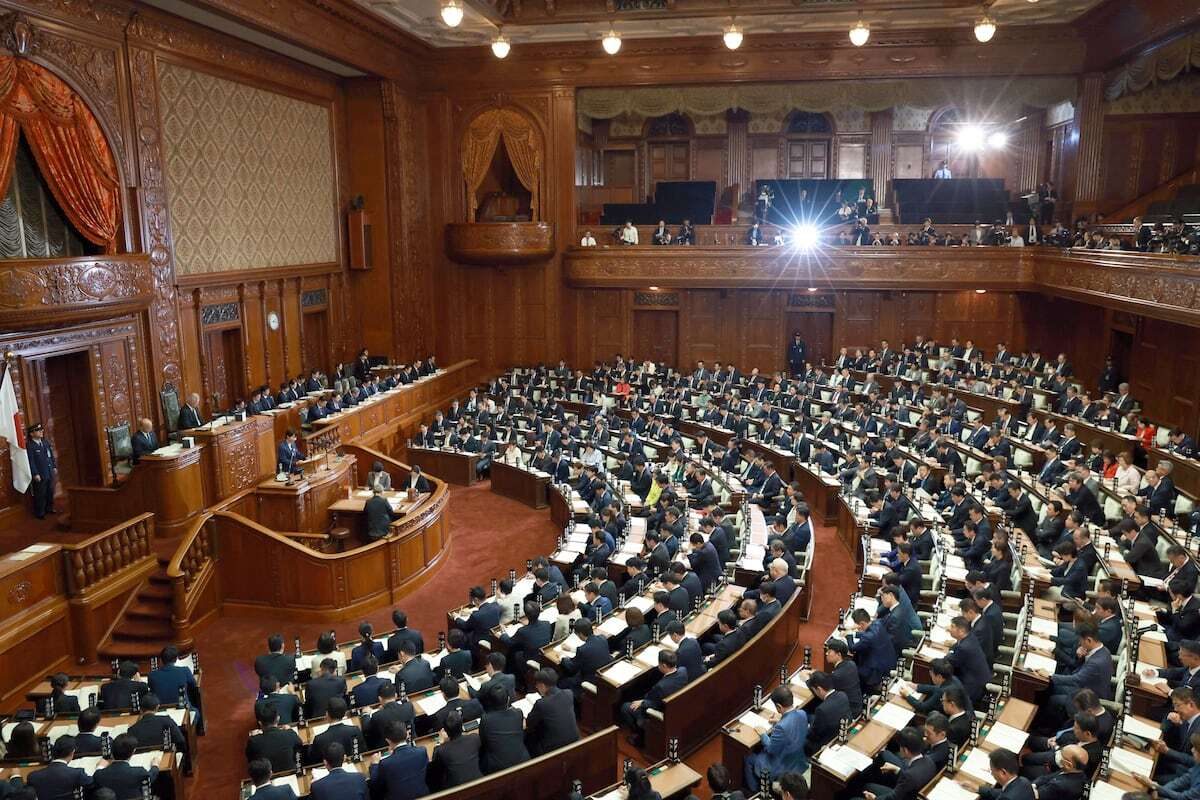
A plan to cut 31 proportional representation seats in the House of Representatives would reduce the number of women elected from 68 to 50, according to an estimate by the Sankei Shimbun. The share of women among all winners would fall from 14.6% to 11.9%. The Communist Party, the Social Democratic Party and others oppose the change, saying it would shrink the number of female lawmakers.
The estimate applies the seat cut, a change to the method of allocating seats and other measures to the results of February's lower house election. It also assumes that the Chugoku and Shikoku proportional blocks stay separate, with 9 seats for Chugoku and 4 for Shikoku. The estimate excludes the idea of a joint list, under which several parties would field candidates on the same proportional slate.
Under the estimate, women elected through proportional representation would fall from 40 to 22. Added to the 28 women elected in single-seat districts, that gives 50, down 18 from the actual 68. Because parties would run short of candidates to fill their allotted proportional seats, 13 seats would go vacant, leaving 421 winners against a total of 434 seats.
In February's election, 28 women won single-seat districts and 40 won proportional seats. Women made up 9.7% of district winners and 22.7% of proportional winners, and about 60% of the 68 women took their seats through the proportional list.
Parties split on the effect
Yamamoto Joji, leader of the Inochi no To party, told a rally outside the Diet on October 28 that proportional representation has helped women enter national politics. "Cutting only the proportional seats would shut minority and diverse views out of the Diet," he said.
Fukushima Mizuho, leader of the Social Democratic Party, told the same rally that incumbents with a local base, a famous name and funding have the advantage in single-seat districts. Proportional representation, she said, is what sends women to the Diet, and she called on the parties not to leave the decision to men alone.
Tamura Tomoko, chair of the Communist Party, said at a press conference on October 30 that the Liberal Democratic Party fields few women. "It's because so many incumbents are men," she said, describing a system built on protecting male incumbents' seats through their local base and name recognition.
Fujita Fumitake, co-leader of Nippon Ishin no Kai, said the electoral system is built to be neutral toward both men and women. He stressed the need to create conditions that support women's participation in politics.
Proportional representation has served as the entry point for women and others who lack a local base in single-seat districts. The pushback against the seat cut rests on concern that this opening would narrow.