
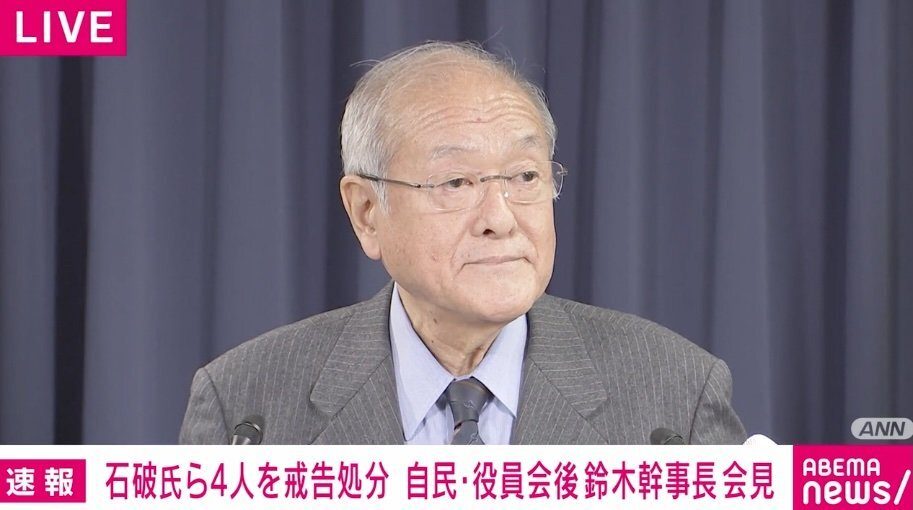
The Liberal Democratic Party has issued a formal reprimand to former Prime Minister Shigeru Ishiba and three other lawmakers who left the chamber before a vote on a consumption tax-cut bill, the party's executive board announced.
Secretary-General Shunichi Suzuki said at a news conference after the board meeting on the 9th that the four had violated party rules by abstaining. The others were former economy and industry minister Yuko Obuchi and two additional lawmakers.
A reprimand against a former party president is highly unusual, and party officials described it as an unprecedentedly strict step in the LDP's history.
The four left the Lower House floor shortly before the vote, citing the bill's unclear funding sources. "Leaving despite being barred from doing so during the plenary session cannot be overlooked from the standpoint of party discipline and unity," Suzuki said.
Process and timing
Suzuki said the party sent written requests for an account of the facts to the four after Friday's plenary session and received replies by noon on the 9th. Asked whether punishing them so soon after the replies was premature, he said the four are veteran politicians who understood the consequences of their actions.
"They acted fully aware of the responsibility and the impact their political conduct would have," he said. "We did not need to take time; we acted on the facts we confirmed."
He said Prime Minister Sanae Takaichi gave no prior instruction or consultation on the matter, stressing that the decision came from the party executive.
No special treatment for former leaders
Asked about the case of former Prime Minister Junichiro Koizumi, who was spared punishment in light of his achievements, Suzuki dismissed the comparison. "The judgment at the time, which took past achievements into consideration, was the irregular one," he said.
"The basic principle is to judge what actually happened and its impact in total, and then decide on punishment," he said, making clear that former prime ministers and party presidents would not receive special treatment.
Suzuki said the timing was driven by the Upper House, where a single vote carries great weight and such conduct cannot be tolerated. "Rather than spending one or two weeks on this, it is better to settle the matter quickly," he said. "Our thinking also included the fact that Upper House deliberations will begin soon."
On the lawmakers' stated concern about funding, Suzuki said the party's policy research council had held lengthy and vigorous debate at a joint meeting. "Those making this argument had ample opportunity to speak," he said. "Raising it as a reason to walk out at the final stage does not add up."
He said only that the party would handle the policy research posts the lawmakers currently hold "properly and without error" in the future.