
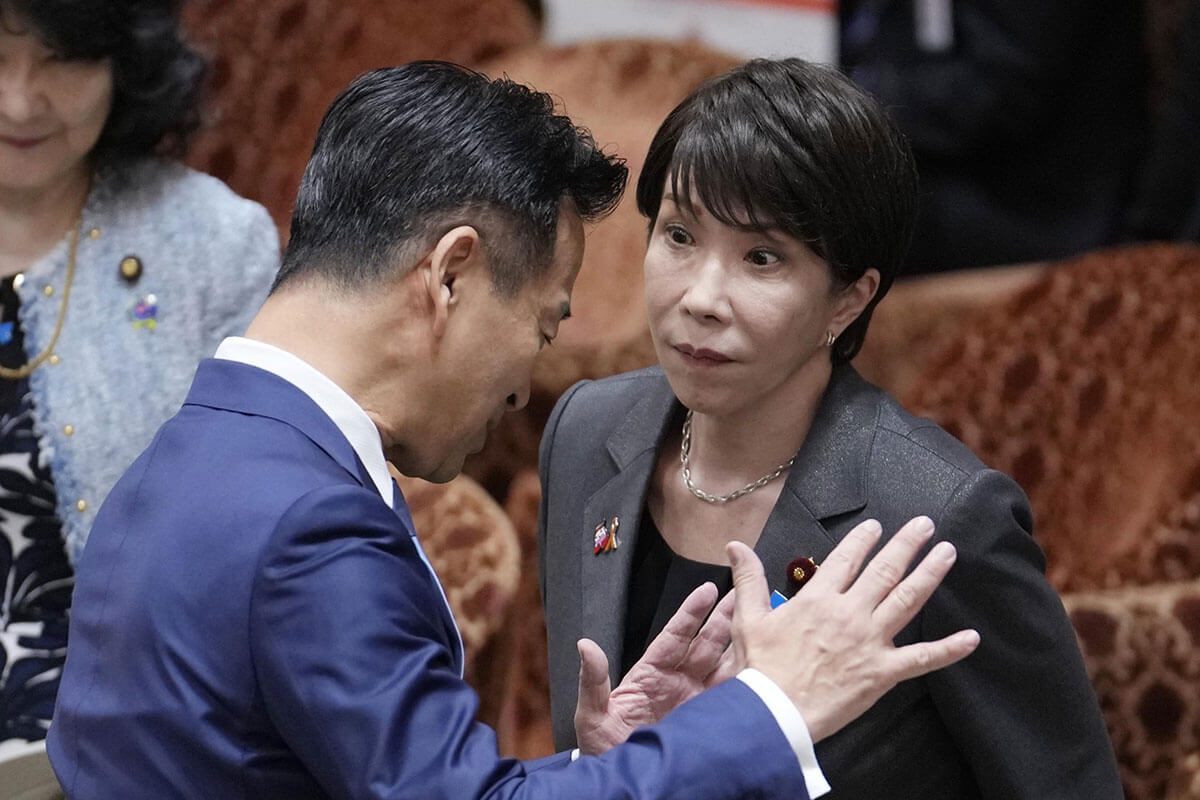
Komeito is trapped between voting for a consumption tax cut it has criticized and being blamed for blocking household relief, as the government courts its votes in an upper house where the ruling bloc holds no majority, Daily Shincho reported.
The cabinet of Prime Minister Sanae Takaichi plans to cut the consumption tax in April and introduce an income-linked benefit for low- and middle-income workers. The benefit would run for two years as an advance program and expand when the tax cut ends.
The bill is under scrutiny in a special upper house committee that opened on the 13th. Asked by a Komeito lawmaker who would qualify for the benefit, Takaichi said the government would study making more than 50% of workers eligible.
She added that about 40% or more of male workers would be expected to qualify.
The ruling coalition is a minority in the upper house, so it needs opposition votes. A source close to the situation told Daily Shincho that the government is keeping its distance from the Democratic Party for the People and has its sights on Komeito.
Takaichi, who is known to dislike the Diet, attended the committee and showed consideration for Komeito's push to widen eligibility, the source said. Her cooperation reflects how badly she needs the party's support.
A record of defending households
Komeito led the introduction of the reduced 8% rate on food and other daily goods when the consumption tax rose to 10% in October 2019. It insisted the rate stay 2 points below the standard rate to ease the burden on households.
That record makes a cut in the reduced rate to 1% from April look like something the party could hardly oppose. Instead, it argues that the benefit's scope and funding remain unclear and that households will suffer when the rate returns to 8% two years later.
Continuing to oppose the government's bill is not in Komeito's interest either, according to the source. The party's main support base, the lay Buddhist group Soka Gakkai, is said to think so.
Spring local elections loom
The key is next spring's unified local elections, when Komeito and Soka Gakkai will have to fight at the local level. The party left the coalition after Takaichi won the Liberal Democratic Party leadership and planned to pressure her from opposition.
A snap general election then arrived. Komeito ran alongside the Constitutional Democratic Party of Japan in a new centrist alliance and suffered a heavy defeat, leaving it without a stage in the current Diet session.
Soka Gakkai, which must deliver votes in those local races, is struggling with the problem, the source said.
The likely outcome, according to the source, is that Komeito will not simply accept the government's bill as written. It will seek changes that reflect its own demands, then vote yes.
A split in the joint caucus
That would not end the matter. A bill amended in the upper house returns to the lower house for another vote.
In the lower house, Komeito sits in a joint caucus called Chudo with the Democratic Reform Association and the Centrist Reform Alliance. The caucus voted against the bill in the lower house, and the three groups were in step.
Komeito may switch to yes in the upper house if its demands are written into the bill. The Democratic Reform Association remains confrontational, so the caucus may be unable to act as one when the amended bill comes back.
That would leave Komeito members voting yes and Democratic Reform Association members voting no. Binding the caucus to a single position would be difficult, and a free vote would put its unity to the test, the source said.
A name the party chose
Support for the Centrist Reform Alliance is below 1% in some polls. The party has one lower house member left to handle its remaining affairs, and the Democratic Reform Association is little better known.
Komeito and Soka Gakkai insisted on the name Chudo because it is close to an ideal they have long cherished, the source said. The party joined the alliance just before the general election despite criticism that it was a mutual election-help society.
Having lost and then failed to hold the caucus together, Komeito would struggle to justify the arrangement to local members, not just to those at the center. Talk is circulating that the Democratic Reform Association will merge with the Constitutional Democratic Party early next year.
Komeito and Soka Gakkai now face a hard choice over whether to abandon Chudo with that in mind, the source said. Either way, the party is left with no good option on the tax cut, only the least bad one.