
The Liberal Democratic Party, Nippon Ishin no Kai and the Democratic Party for the People met at the Diet on the 5th to work out the details of lower house electoral reform. The three parties are pushing toward legislation covering the items they have agreed on, including a cut of 31 proportional representation seats.
Their agreement tightens the threshold for candidates who run in both a single-seat district and on a proportional list and return to the Diet after losing the district. The minimum share of the valid vote needed for such a comeback rises from one-tenth to one-sixth, a change aimed at blocking candidates who win very few votes.
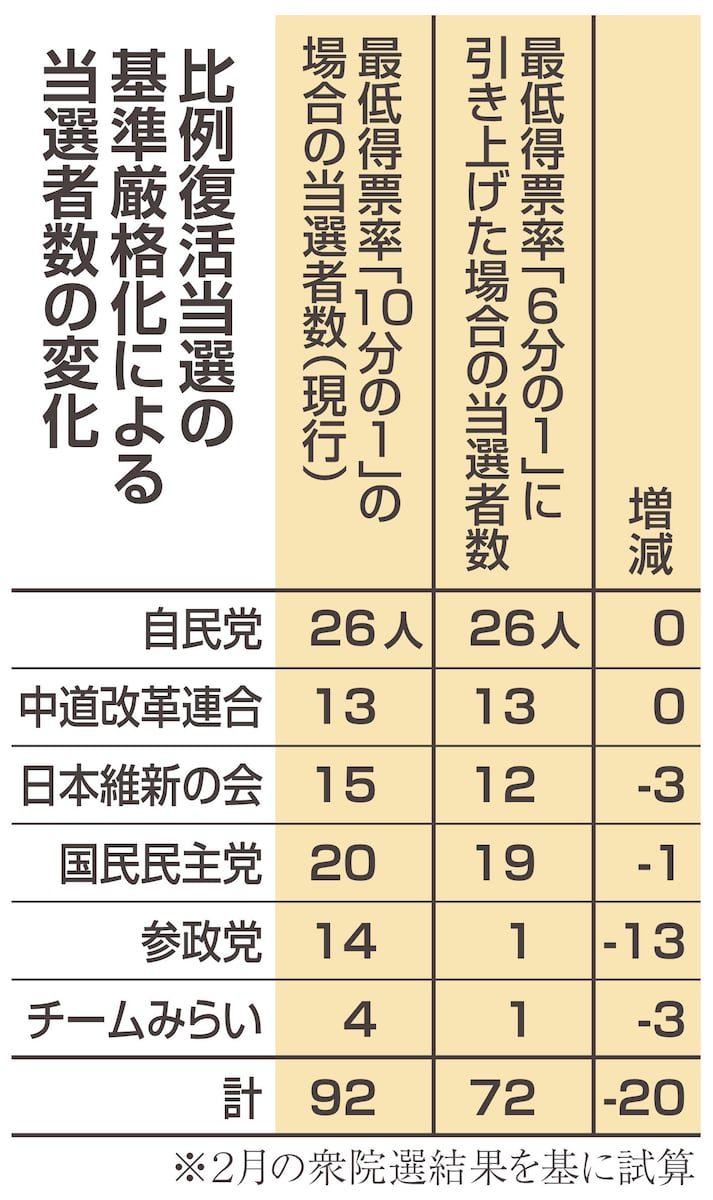
In February's lower house election, 92 candidates who lost their single-seat districts returned through proportional representation. Applying the one-sixth threshold to that result leaves 72 able to return. The other 20 fall short and lose their seats.
Who loses under the new threshold
By party, the LDP, with 26 comeback members, and Chudo Kaikaku Rengo, with 13, have no member below one-sixth and keep all of them. Ishin falls from 15 comeback members to 12, the DPFP from 20 to 19 and Team Mirai from 4 to 1.
Sanseito is hit hardest. Fourteen of its candidates returned through proportional representation in February. Under the one-sixth rule only one would, and the agreed cut of 31 proportional seats would take that seat as well.
Sanseito runs candidates in many single-seat districts to build up its proportional vote. Sohei Kamiya, the party's leader, rejected the stricter threshold as "harassment of a small party like Sanseito, and the exclusion of the public will."
Voters have long complained that the current system, which lets a candidate return through proportional representation after losing a district, is hard to understand, and such members are mocked as "zombie lawmakers." Ishin co-leader Fumitaka Fujita said tightening the rule "has the effect of raising trust in and acceptance of the electoral system."