
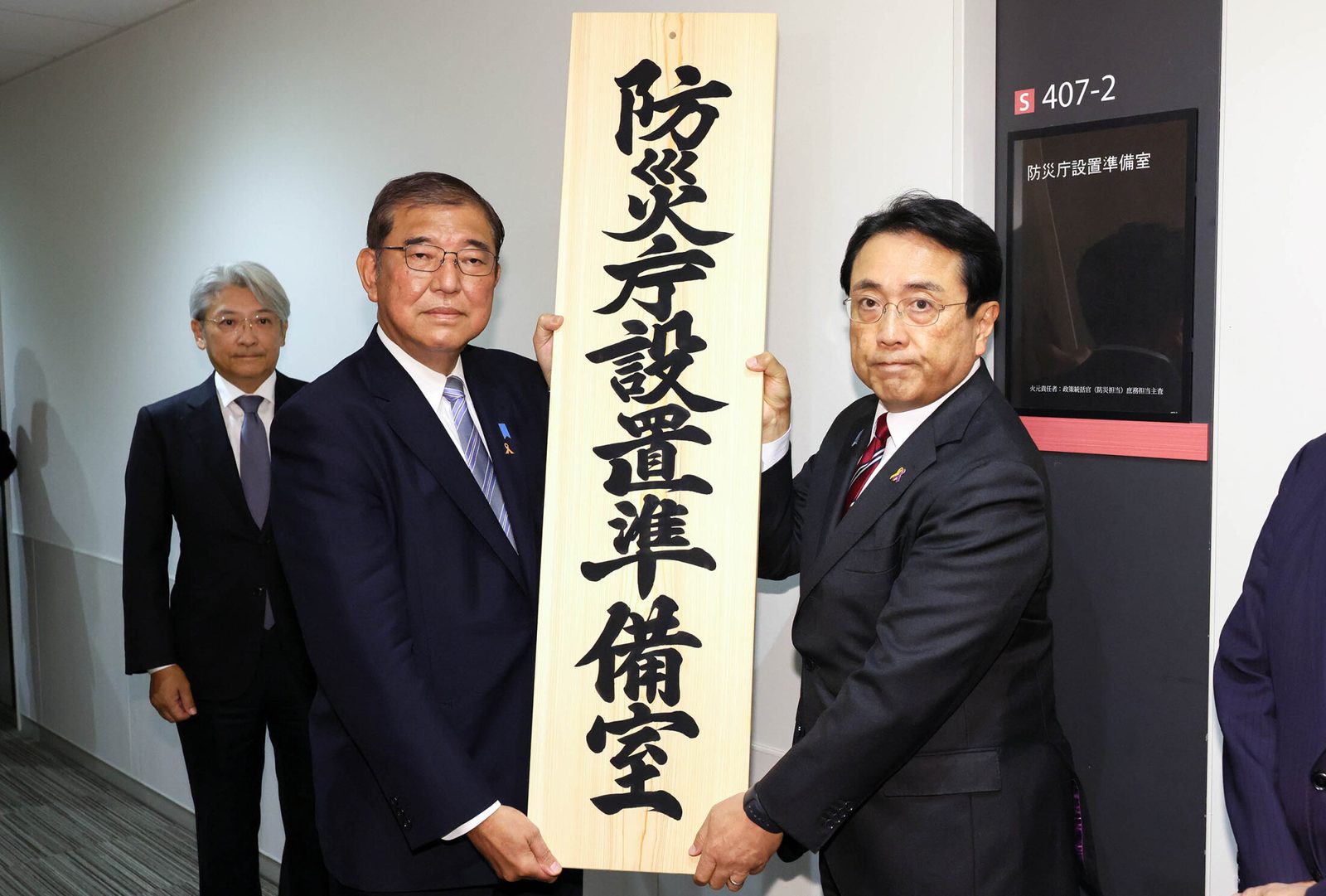
Japan's new Disaster Management Agency was launched on November 2, taking over a portfolio that had been in preparation since the tenure of former Prime Minister Shigeru Ishiba. The law establishing it passed the Diet in July.
The agency sits under the prime minister and covers everything from the Nankai Trough earthquake and the Japan Trench and Chishima Trench earthquakes to a Mount Fuji eruption and a major Tokyo earthquake — disasters the government classes as national crises. It also handles heavy rain, volcanoes and other natural hazards.
It is divided into four units: general policy, covering budget, personnel and public relations; disaster response, covering large-scale operations, training and personnel development; disaster planning, covering risk assessment, countermeasures and pre-disaster prevention; and community disaster management, covering digital technology, industry-academia-government support, public awareness and disaster education.
The agency describes its role as a command center for "thorough promotion of pre-disaster prevention" and for consistent disaster response from the moment a disaster strikes through recovery and reconstruction.
A staffing gap left by the Cabinet Office
Until now the Cabinet Office's disaster management division coordinated the government's disaster policy and supported local governments, but it was badly short of staff, said Riiku Oyama, a deputy counselor in the agency's disaster planning division, in an interview.
When the Noto Peninsula earthquake struck in January 2024, the division had only about 110 people and effectively one senior post, Oyama said. Nearly all of its staff were sent to handle the response, and work on pre-disaster prevention had to be suspended in the meantime.
With a disaster on the scale of the Nankai Trough quake possible at any time, the government needed a structure that could pursue prevention and respond to disasters at the same time, he said.
The new agency has assembled its full complement of 352 staff, drawn from transfers from ministries and local governments and from former Self-Defense Forces members and volunteer firefighters. It aims to combine the experience those staff bring from other ministries and local governments with the expertise of its own recruits.