
Seven days short of a year since Prime Minister Sanae Takaichi told a Diet budget committee that a Taiwan contingency could amount to a "survival-threatening situation" in which Japan may exercise collective self-defense, ties with China remain in a worsened state. On September 28, a former foreign minister went to Beijing with a proposal to break the deadlock and came back without a commitment.
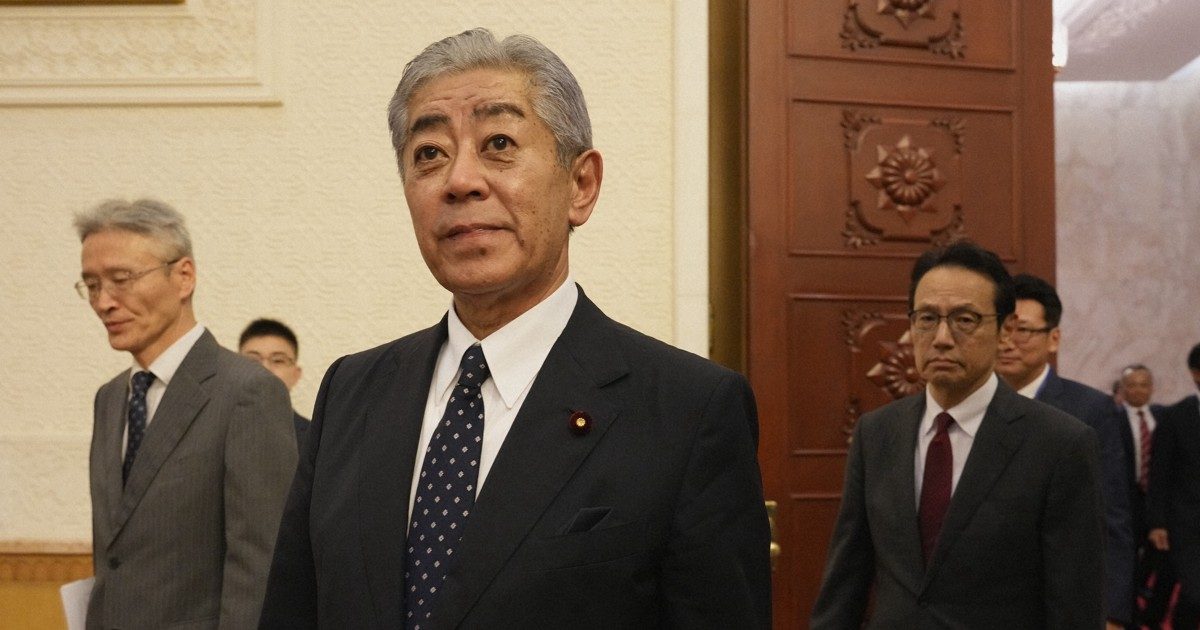
Takeshi Iwaya, who stepped down as foreign minister, met Chinese Foreign Minister Wang Yi in the Great Hall of the People as chairman of the Japan-China Economic Association, a private body. Wang opened with a blunt reading of Takaichi's November answer to the Diet, according to people familiar with the meeting.
“We do not regard it as a slip of the tongue. It is an expression of the view of history that Prime Minister Sanae Takaichi has held for many years.”Wang Yi, Chinese foreign minister
Wang went on that if it was a mistake it should be withdrawn at once, and if it was deliberate it must be withdrawn all the more, calling it far removed from the spirit of the four political documents and no longer a matter of one individual, the people said. Iwaya replied that retracting words spoken by a national leader carries a very high political hurdle.
A proposal to restate the four documents
The 1972 Japan-China Joint Communiqué, one of those four documents, states that Japan "fully understands and respects" China's position that Taiwan is an inalienable part of Chinese territory. Iwaya proposed that the two governments reaffirm the four documents at a senior level, and told Wang the step would be effectively equivalent to withdrawing the Diet answer.
Wang neither accepted nor rejected the proposal. He said a Chinese saying holds that the person who caused a problem should be the one to solve it, and that Japan's leaders should settle this one, according to the people. He added that China is open to dialogue, but that dialogue must be conducted in order to solve problems.
Iwaya described the proposal as his personal view, noting that the economic association is a private organization. The account of the meeting was cut off there in the published report.
With the exchange showing no agreed way back, Tokyo's informal contacts with Beijing, the channels that have kept past disputes from hardening, are thinning. Iwaya's trip was made outside government, and the answer Wang gave him left the issue with the leaders of both countries.