
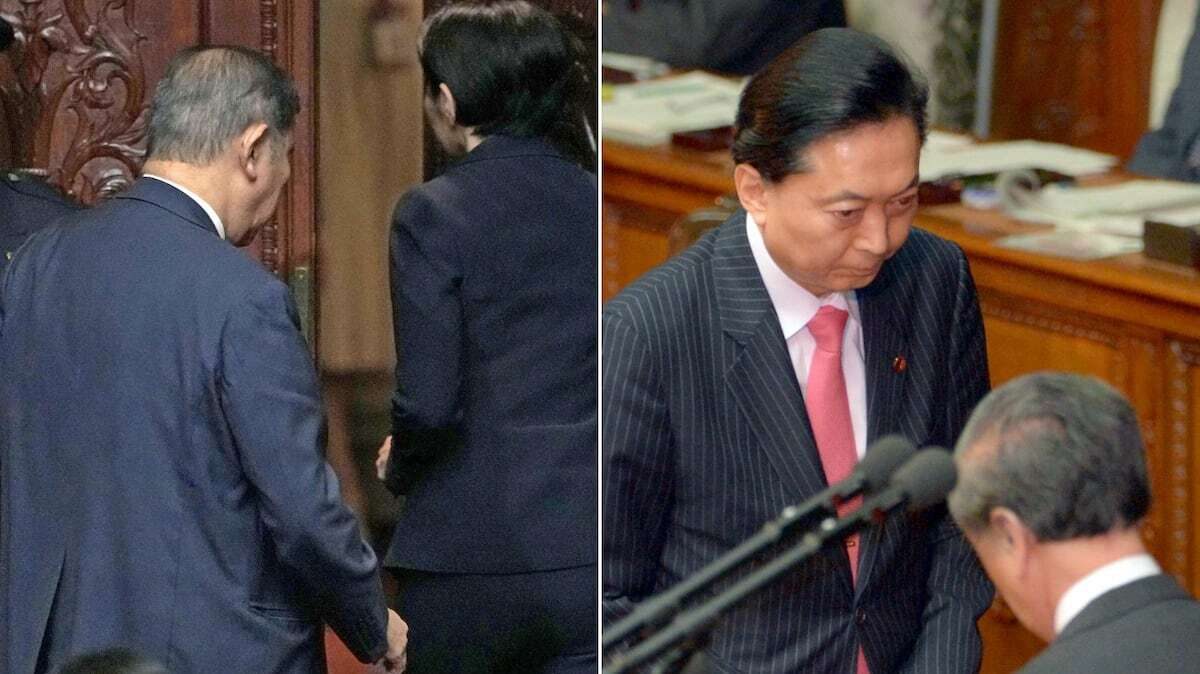
Shigeru Ishiba, the former prime minister, left the floor of the House of Representatives on the 6th rather than take part in a vote on a bill to cut the consumption tax on food and drink. Fourteen years earlier, Yukio Hatoyama, also a former prime minister, voted against his own party's plan to raise the same tax. Ishiba criticized Hatoyama's vote sharply at the time.
Both acted against their party's position, and both described the choice as one of conviction. The parallel is the one Ishiba drew himself, in the opposite direction, in 2012.
Leaving the chamber
Ishiba stood up from his seat just before the vote, at almost the same moment as Yuko Obuchi, a former head of the party's election strategy office. Obuchi stopped at the exit door and bowed toward the chamber. Ishiba, walking behind her, gave a slight bow as he went and followed her out.
Afterward he told reporters the funding for the bill was not clear and that it would damage the public finances. "The currency weakens, interest rates rise, prices go up. I cannot dispel those concerns," he said. He said he could not simply oppose the bill, and that he had listened to the debate and made a final judgment, which was to leave rather than vote against it.
The 2012 revolt
Hatoyama voted against the consumption tax increase on June 26, 2012, when the Democratic Party of Japan under Yoshihiko Noda pushed through legislation on social security and tax reform. The bill would have raised the rate from 5 percent to 10 percent in stages.
Speaking to reporters on the 9th of that month, before the vote, Hatoyama said he had fought the election that changed government on a pledge not to raise the consumption tax for four years, and would decide in light of that responsibility. He put weight on the manifesto the party had carried into the 2009 general election.
Fifty-seven DPJ lawmakers voted against the increase, including Hatoyama and Ichiro Ozawa, a former party leader, and 15 abstained or stayed away. Ozawa and his group left the party and formed a new one, People's Life First. Hatoyama stayed.
“I act inside the party. Mr. Ozawa acts outside it. That is the difference.”Yukio Hatoyama, former prime minister
The party leadership first considered suspending his membership for six months, then cut it to three after a recommendation from the party ethics committee. The Liberal Democratic Party, then in opposition, objected to the lighter penalty. Nobuteru Ishihara, the LDP secretary-general, said the Democrats were soft on their own.
The demand to quit
Ishiba's own words from that period are the ones now turned back on him. He said then that lawmakers who voted against the party's tax plan should leave it without delay. Sankei Shimbun reported the comparison between the two episodes.
The LDP has since asked Ishiba, Obuchi and two other lawmakers who left the chamber, Yoshihisa Furukawa and Hajime Funada, to explain themselves by the 9th, Kyodo News reported.