
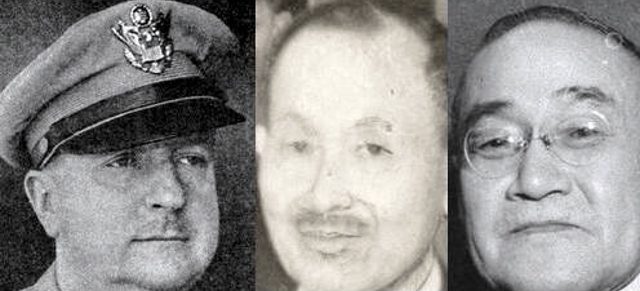
At 10 a.m. on Feb. 13, 1946, four officers from the GHQ's Government Section arrived quietly at the foreign minister's official residence in Azabu Ichibeicho, Tokyo. Charles Kades, Milo Rowell and Beate Sirota's colleague — the American known as "Hassy" who drafted the preamble to Japan's postwar constitution — came with section chief Courtney Whitney. Shirasu Jiro, the Japanese government's liaison to GHQ, led them to the sunroom.
Waiting there were Foreign Minister Yoshida Shigeru, under the Shidehara Kijuro cabinet, and Matsumoto Joji, the minister in charge of the constitution. Whitney sat with his back to the sun and spoke slowly, according to the Asahi Shimbun's account of the drafting. The draft the Japanese side had submitted, he said, was "completely unacceptable to the Supreme Commander as a document of freedom and democracy."
“The Supreme Commander is fully aware that the Japanese people earnestly desire a free and enlightened constitution to protect themselves from past injustices and despotic rule.”Courtney Whitney, chief of the GHQ Government Section
Whitney told the ministers that MacArthur had instructed him to present the document as a concrete expression of the principles the Supreme Commander had in mind. He then handed over the GHQ's draft constitution. The American officers left the room so the Japanese side could discuss it. Shock and concern were plain on Yoshida's face.
MacArthur's bargain: the emperor and Article 9
MacArthur, the Supreme Commander, argued for protecting Emperor Hirohito while making the renunciation of war a pillar of the new constitution. The Japanese side, caught off guard, resisted the war-renunciation clause as written. It argued that the abandonment of war should be stated in the preamble rather than in the body of the constitution.
The constitution was promulgated 80 years ago. Debates over revising it continue in the Diet, and the record of how the pacifist clause was negotiated sits at the center of them.
The Asahi Shimbun is running a six-part series on Hassy, the American who wrote the first draft of the preamble and built his hopes for peace into it. The series draws on the large volume of papers he left behind.