
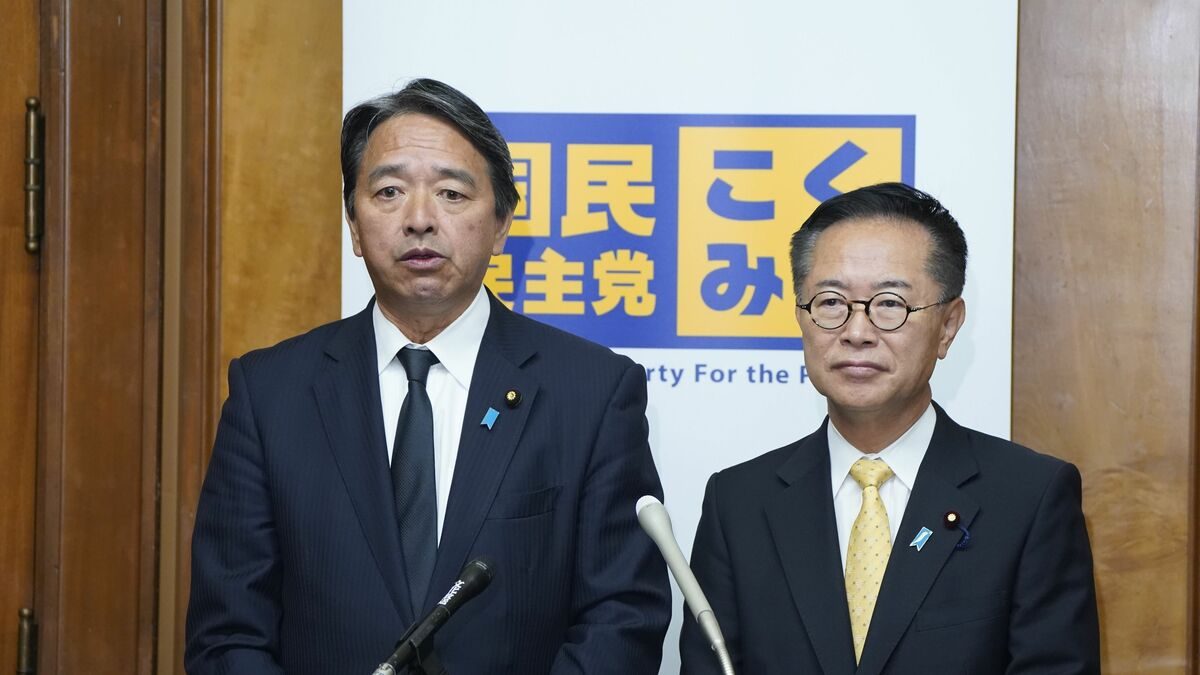
The Democratic Party for the People wants the Diet to take up a bill revising rules on corporate and group donations before a bill cutting 31 proportional-representation seats in the House of Representatives, the party's Diet affairs chief said at a press conference on November 4.
Motohisa Furukawa, who chairs the DPP's Diet affairs committee, argued that the three rival donation bills carried over from the previous session should reach a conclusion first, since they are expected to go to the same committee as the seat-reduction bill. He cited the first-in, first-out principle that governs committee deliberation, Jiji Press reported.
Furukawa also stressed that the DPP judges each issue on its merits and will keep arguing positions unchanged on matters outside the three-party agreement, according to the same report.
Ishin pushes back
Nippon Ishin no Kai co-leader Fumitake Fujita countered that the three-party agreement should simply be advanced first. Distrust is said to be spreading inside Ishin that the DPP is trying to drag out the bill-drafting talks and push the seat cut back, the Asahi Shimbun reported.
The Liberal Democratic Party, Ishin and the DPP agreed on October 29 to cut 31 proportional seats, switch to a modified Sainte-Laguë method for allocating seats, merge the Chugoku and Shikoku proportional blocs, and allow multiple parties to run on a joint list. The three plan to submit the bill to the current Diet session jointly.
The DPP had originally called for a cut of 19 seats. It cited the inclusion of most of its demands, including the joint-list provision, as its reason for backing the deal.
A charge of flip-flopping
Criticism has appeared online that the DPP changed course after public pushback against the three-party agreement. Yasushi Adachi, a DPP member of the House of Councillors, rejected that squarely as wide of the mark.
Adachi's argument comes down to three points. First, handling political-funds bills that were already carried over before an election-system deal reached later is exactly what first-in, first-out committee management requires.
Second, electoral rules and political funding are separate matters. Agreeing on the 31-seat cut and a joint list does not mean the party has settled the LDP's corporate and group donation problem, he argued.
Third, the agreed points will be turned into a bill with nothing added or subtracted, so nothing has been broken. The 31-seat cut combined with a joint list is a one-shot stopgap meant to encourage a realignment suited to a multi-party era, and that understanding has been consistent from the start, he said.
The writer of this column has repeatedly criticized the three-party agreement, seat cut included, and that assessment has not changed. But calling Furukawa's position a policy reversal is indeed off target. What may follow is some interesting political maneuvering, and if it works, views of the DPP could shift substantially.