
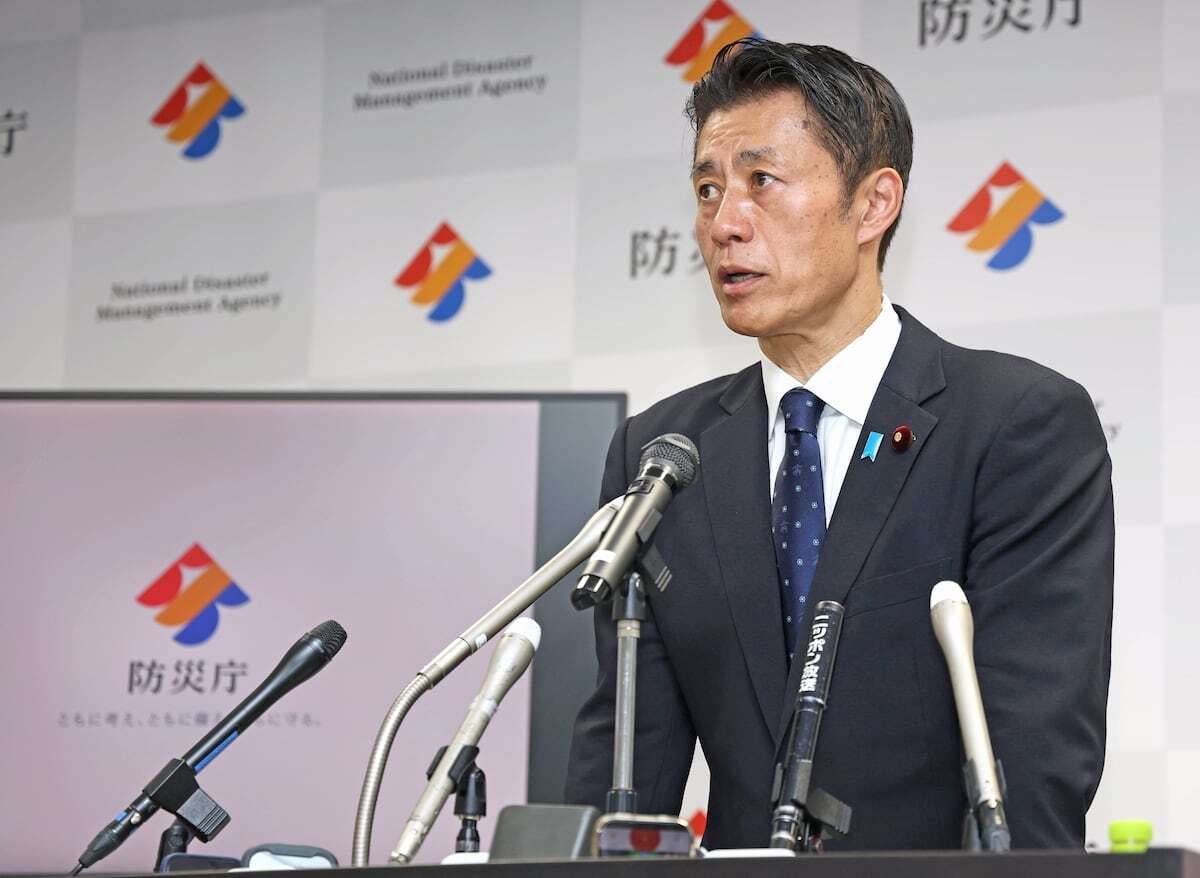
Disaster management minister Goshi Hosono said on Tuesday that a massive disaster such as a Nankai Trough earthquake would be "a fight staked on the fate of the nation," and that a botched response would make "the decline of Japan as a nation unavoidable." He was speaking at a press conference marking the launch of the Disaster Management Agency.
Hosono drew on the 2011 earthquake and tsunami, when he served as a senior aide to then-Prime Minister Naoto Kan in the Democratic Party of Japan government. With the Self-Defense Forces fully mobilized for the tsunami and the Fukushima Daiichi nuclear accident, he said he kept asking himself whether Japan could respond if a security emergency broke out at that moment.
At the time, he said, "there was sympathy for Japan. There was an atmosphere in the world that attacking Japan when it was this weakened was simply not possible." Fifteen years on, he said the international situation has changed greatly and "rather than that, the possibility that someone will strike has emerged." He did not name any country.
Cyberattacks alongside disasters
Hosono said Japan must prepare for cyberattacks and other attacks occurring at the same time as a disaster. The Disaster Management Agency cannot handle that alone, he said, and "the government as a whole has to think this through properly." He has discussed the issue with Defense Minister Shinjiro Koizumi and said he recognizes it as "an extremely serious challenge."
Shelters as the test of change
Hosono put the need to improve evacuation shelters at the center of his remarks. He said he has repeatedly asked agency staff to imagine whether they would accept a shelter for their own children or parents: "Can you accept that food? Can you use that toilet? Unless we work with that level of awareness, shelters will not change."
He listed what shelters need: hot meals, clean toilets, beds where people can rest with peace of mind, and somewhere to bathe. "For the public to accept that Japan's disaster response has changed, the shelters have to change," he said.
Reflecting on past visits to disaster areas, Hosono said the people he most wants to help are elderly residents. "Frankly, the people I feel sorriest for in shelters, the ones I want to do something about, are the elderly," he said. Giving older people a safe evacuation and the means to rebuild their lives is the priority, he said.