
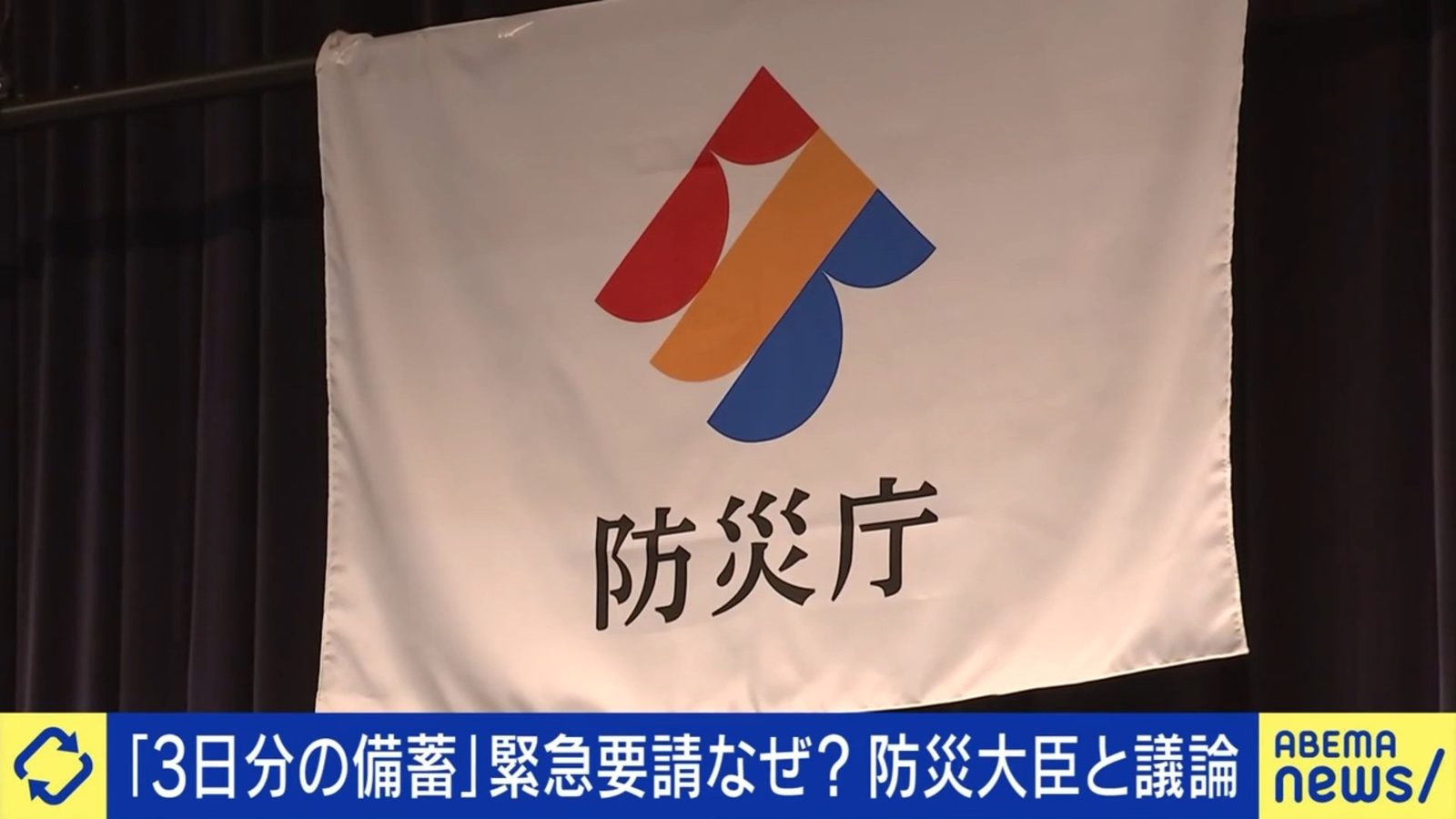
Japan's new Disaster Management Agency (防災庁) opened on November 2, and the same day the government issued an unusual emergency request urging households to stock at least three days of food and water, and a week if they can. The request, issued on Disaster Management Minister Goshi Hosono's initiative, also asks people to secure furniture and check hazard maps.
Online, the timing prompted alarm. Social media users asked why the request was suddenly urgent and whether the government knew something it had not disclosed. The spread of similar preparedness calls in Britain, Belgium, the Netherlands and Finland around the same period fed speculation that the warning was tied to a cyberattack on infrastructure or to preparations for a third world war.
Comedian Taima Matsushige of the duo Pekopa said on ABEMA Prime that he had felt uneasy hearing of stockpile requests in Britain and talk of a solar flare arriving at the same time. He said gas canisters were selling out at his local supermarket and that he had bought extra water himself.
Hosono denies any hidden warning
Hosono rejected the theories outright. "Earthquakes cannot be predicted with current science," he said. "No information reached me alone that an earthquake was likely, and this has nothing to do with other countries' requests."
He pointed to the government's own probabilities: a 60 to 90 percent chance of a Nankai Trough megaquake within 30 years, and a 70 percent chance of a quake directly under the capital. "Looking objectively at how often disasters occur in Japan, one could happen at any time," he said.
Why the request came with the agency's launch
Hosono said he wanted to head off the expectation that the new agency would take care of everything. "With the Disaster Management Agency, the national government steps forward on responses that had been left too much to local authorities," he said. "People will expect disaster response to improve, but if that turns into leaving it to the government and to politicians, our ability to respond actually falls. I wanted to avoid that."
He described the difficulty of opening an estimated 20,000 evacuation centers at once after a Nankai Trough-scale disaster and reaching everyone who needs help. Older people and people with disabilities must get priority access to official stockpiles and staff, he said. "If people who can manage on their own hold out for at least three days, and a week, I think help can reach them. Acting for yourself connects to helping those who are vulnerable."
Checking a hazard map costs nothing, he added, and tells residents whether their area faces flood risk and whether they would need to evacuate. "To truly raise our disaster resilience, people have to act. A strong country cannot be built otherwise."
Kyoko Tominaga, an associate professor at Ritsumeikan University, suggested on the program that the aim was less self-help than self-reliance, raising the capacity of people who have become consumers of services to do things for themselves. Hosono agreed. "However much the framework of public assistance expands, in the end a country is stronger when more of its people are self-reliant," he said.