
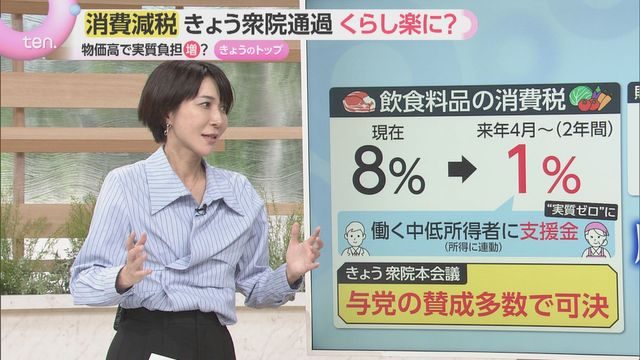
A bill to cut the consumption tax passed the House of Representatives with its funding still unsettled, and it now goes to an upper house where the ruling coalition holds a minority, Yomiuri TV reported.
Prime Minister Takaichi has said she wants to secure funding without relying on special deficit-covering bonds. She has pointed to reviews of both spending and revenue.
Opposition parties say the government has still not offered a concrete and convincing explanation. The bill's passage through the House of Councillors is now the decisive stage.
What households would gain and lose
A private survey asked whether people would feel relief if the consumption tax on food fell to 1%. Just 18.4% said they would.
For a family of four over one year, subsidies on electricity and gas bills would cut costs by about ¥7,000. The food tax cut would save about ¥62,528.
Costs rise elsewhere. Gasoline charges are set to be raised gradually, adding about ¥11,003, and inflation adds about ¥87,000.
Netting these out, the family pays about ¥28,475 more. The estimate is an average, and circumstances differ by household.
Support payments scaled to income are also under consideration for middle- and low-income workers. Those would require new funding of their own.
Restaurants fear a rush to takeout
In a survey of restaurants, about 70% of operators said the plan would have a negative effect. They worry diners will assume eating out carries a heavier tax burden.
Operators fear customers will shift to takeout. Premium shopping vouchers and the Go To Eat campaign are among measures under consideration.
Many restaurants turned to takeout under pressure during the coronavirus pandemic. Owners recall starting it out of desperation, with almost no profit.