
A bill to cut the consumption tax on food and drink and to create a new income-linked benefit system passed the lower house with all opposition parties opposed. After more than 30 hours of debate, the government has given almost no detail on how the cut would be funded or who would receive the benefit, and criticism has not died down.
The ruling bloc is not united either. Four Liberal Democratic Party members left the chamber before the vote on November 6, and the bill's passage through the upper house is hard to predict.
In the lower house session that day, Isamu Isa of Komeito asked whether the bill should be resubmitted once its contents were settled. Opposition benches applauded loudly, the Hokkaido Shimbun reported.
Benefit system has no figures in the bill
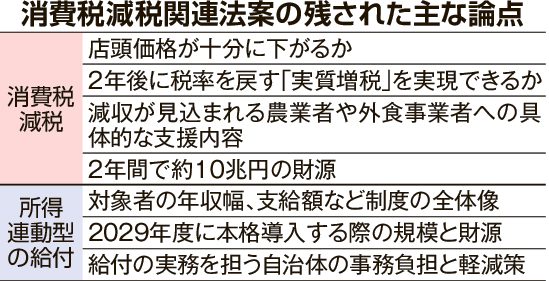
The biggest objection in the lower house was that the shape of the new benefit system, due to start in fiscal 2027, remains invisible. The bill names neither recipients nor payment amounts. The government has offered "reference figures" in debate but no concrete policy, and opposition parties have called this a contempt for the legislature.
Prime Minister Sanae Takaichi, who had been pressed hard to attend committee sessions, appeared only on November 6. Her explanation went no further than saying the benefit would cover more than 30% of workers and that the income ceiling would be set above ¥3.5 million. She took questions for one hour, half the time the opposition had demanded.
Yuichi Goto, Diet affairs chief of the lower house group Chudo, told reporters the outcome showed the limits of a small opposition party's power.
Most of the contested points were left unresolved: the income floor, payment amounts by income level, the scale of the full rollout in fiscal 2029, and the funding for the tax cut.
The government is releasing information in small pieces, which is seen as an attempt to leave room for negotiation so that it can win support from some opposition parties. The ruling bloc is four seats short of a majority in the upper house. The Japan Conservative Party, which holds two upper house seats, has said it supports the bill. The government is also looking to bring in the Democratic Party for the People and Komeito, both of which are keeping their distance from the LDP.
Four LDP members walk out
In the November 6 session, four LDP members left before the vote: former Prime Minister Shigeru Ishiba, former election strategy chief Yuko Obuchi, former Economic Planning Agency director-general Hajime Funada and former justice minister Yoshihisa Furukawa. They cited doubts about the effect of the tax cut and about the public finances. The party's unity could fray in the upper house as well.
“If a small opposition party hit its limits in the lower house, a small ruling party may have a rough time in the upper house.”an LDP heavyweight, quoted by the Hokkaido Shimbun
The bill now goes to the upper house, where the questions the government has not answered will be waiting.