
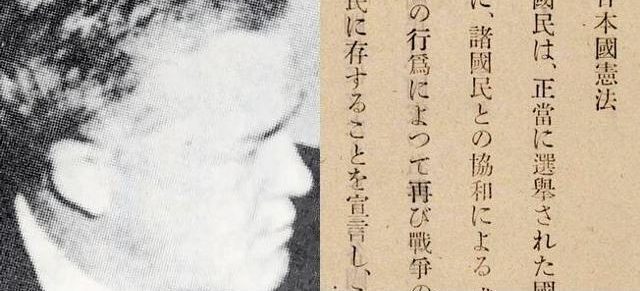
Japan's constitution marks 80 years since its promulgation on Nov. 3. Its preamble and Article 9, the renunciation of war, open with the same words: "The Japanese people."
In Article 9, that subject was added in a revision by the Imperial Diet, carrying the clause about sincerely seeking international peace based on justice and order. The preamble's version came from the draft constitution presented by GHQ, the General Headquarters of the Allied Powers that occupied postwar Japan.
One man at GHQ tried to tie the preamble's vision of peace to the renunciation of war while the draft was being written. Alfred Rodman Hussey Jr. was a US Navy commander and lawyer who drafted the preamble in GHQ's Government Section, which handled Japan's democratization. His surviving papers lay out the idea.
A right to live in peace
In February 1946, work on a new constitution was under way at GHQ. One of three principles set out by Supreme Commander Douglas MacArthur was the abolition of war, including even the right of self-defense. The question was how to write that into the constitution.
Hussey wanted the text to show not only that the Japanese people renounced war but how they would keep the peace. His clue was the "right to live in peace" he wrote into the preamble, which states that all peoples have the right to live in peace, free from fear and want.
Japan would take the lead in international cooperation for the peace on which everyone's survival depends. Gaining the world's trust that way would in turn protect the survival of the Japanese people.
In Hussey's drafts, the preamble's commitment to international cooperation and the article renouncing war were considered not as separate pieces but as a single design.
Eighty years after promulgation, with divisions among nations only deepening, how to achieve peace without force through international cooperation remains an open question. Hussey's design poses it again.
From peace without force to a basis for defense
The right to live in peace that Hussey wrote into GHQ's draft, and which passed into the constitution, later changed character: the vision of peace without reliance on force became a basis for Japan's defense.
The struggle between ideals and reality was there from the time the GHQ draft was being written. In February 1946, Hussey clashed with his superior in the Government Section, Charles Kades.