
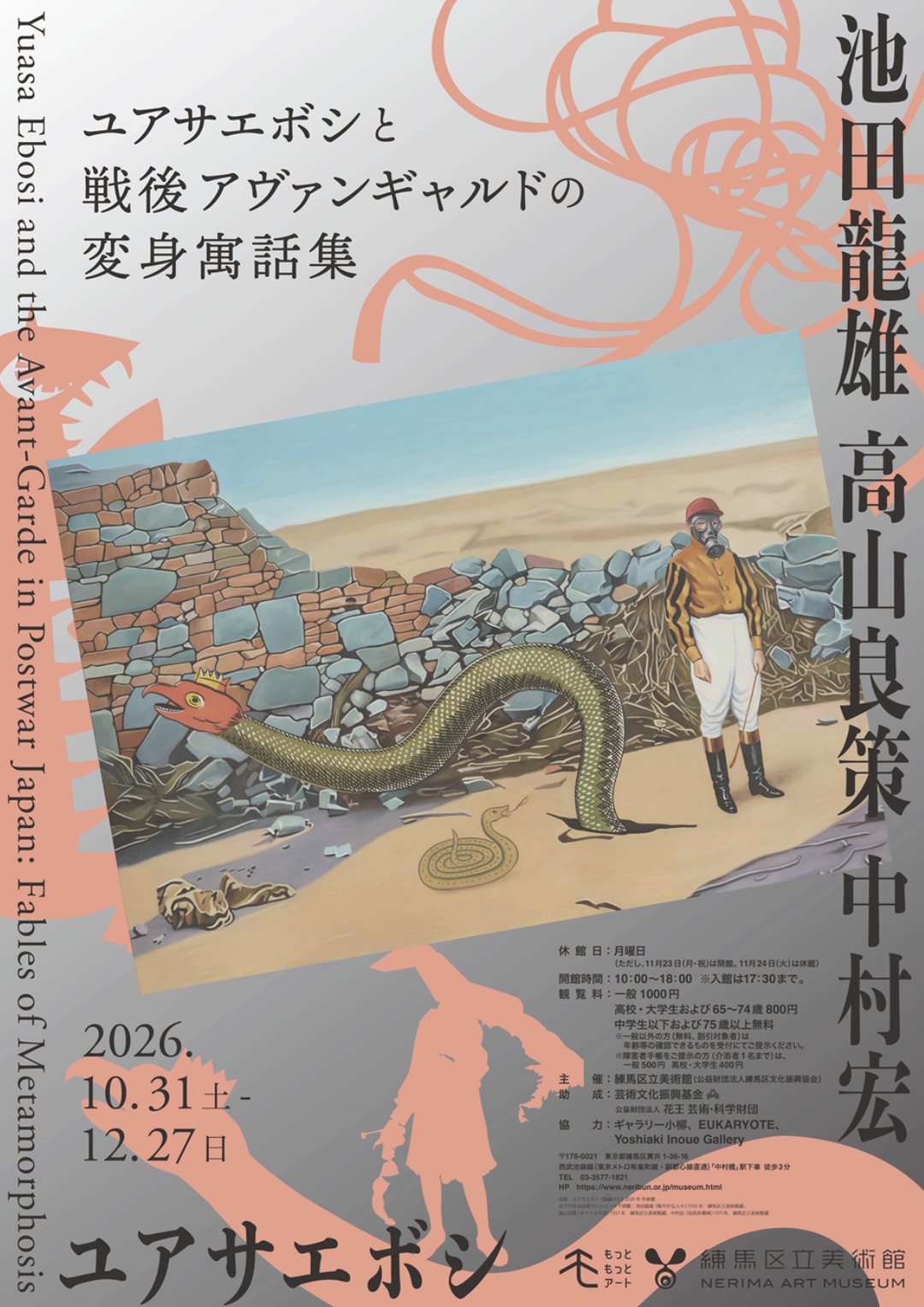
The exhibition brings together the contemporary artist Yuasa Ebosi (born 1983) with Ikeda Tatsuo (1928–2020), Takayama Ryōsaku (1917–1982), Nakamura Hiro (1932–2026) and others who pursued avant-garde art in postwar Japan, taking metamorphosis as its keyword. Yuasa builds paintings by combining images gathered from old magazines, newspapers and the internet. Alongside the paintings, Yuasa has created and presented the life story of a fictional third-rate painter born in the Taisho era, "Yuasa Ebosi" (1924–1987).
Because Yuasa transforms into this invented, deceased painter by painting from images of the past, the artist calls the practice "mimicry" and attempts to move back and forth between the postwar era in which "Ebosi" supposedly lived and the present. New works are shown here, and with them new events are added to "Ebosi's" chronology, revealing new stories behind the works. After the Second World War, avant-garde artists depicted the memory of war, the contradictions of postwar society and the changing image of the human being through figures of wounded and distorted people, chimeric monsters and uncanny masks.
These expressions grew out of the deep insight into reality of artists drawn to Surrealism and the reportage painting movement. By painting transformation and deformation of familiar forms, they opened up distinctive worlds that conveyed the events behind them as fables. Along with Ikeda, Takayama and Nakamura, whose works are held by the museum, and Yuasa, who has focused on their expression, the exhibition introduces Akutagawa (Madokoro) Saori (1924–1966), Katsura Yukiko (1913–1991), Tsuruoka Masao (1907–1979) and Furusawa Iwami (1912–2000).