
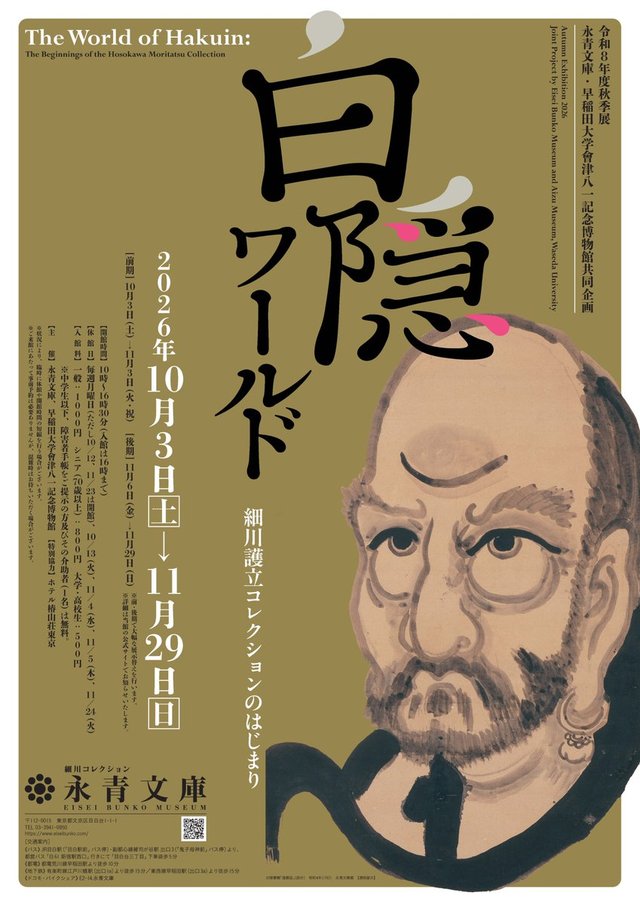
The Zen monk Hakuin Ekaku (1685–1768), called the reviver of the Rinzai school, left behind a vast body of paintings and calligraphy through which he spread Zen teaching. This exhibition looks at how that work reached Tokyo collections. Hosokawa Moritatsu (1883–1970), founder of the Eisei-Bunko Museum, fell ill with pleurisy at sixteen.
While recuperating he read Hakuin's writing and was so moved that he began collecting the monk's work. Eisei-Bunko now holds more than 300 Hakuin paintings and calligraphy, one of the largest such collections in Japan in both quantity and quality. The Waseda University Aizu Yaichi Memorial Museum holds about 900 works gathered over many years by Tomioka Shigenori (1896–1979), first president of Nippon Jukagaku Kogyo.
Roughly a third of them are early modern Zen painting and calligraphy. No record explains why Tomioka collected them, though most were acquired in the later part of his life. The two museums carried out a joint survey of Hakuin and related Zen works in the Eisei-Bunko collection.