
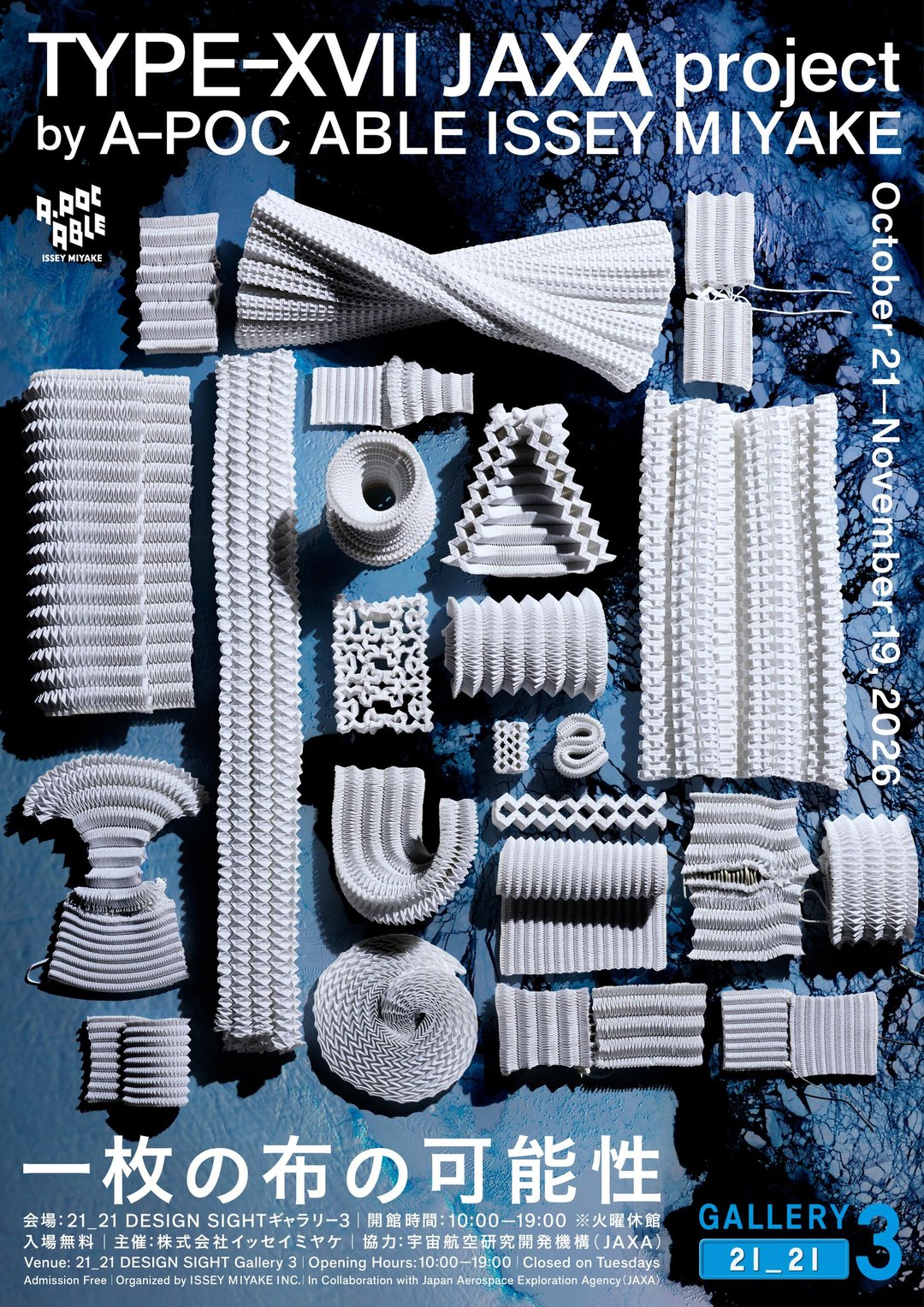
The collaboration between A-POC ABLE ISSEY MIYAKE and the Japan Aerospace Exploration Agency (JAXA) began where two viewpoints at different scales meet: the study of the relationship between body and clothing, and the observation of Earth from space. The exhibition crosses the fields of science and design to reconsider Issey Miyake's idea of "a single piece of cloth" and to explore what future garment-making might become. The starting point is imagery of the Antarctic continent captured by the climate observation satellite Shikisai (GCOM-C).
JAXA observes the global environment continuously through the development and use of satellites, and Shikisai records the state and change of oceans, snow and ice, and vegetation using wavelengths beyond human sight, from near-ultraviolet to thermal infrared. Its data underpin thinking on climate change and other issues while also recording the shifting beauty of the planet. In the Antarctic images, a vast ice sheet roughly two kilometres thick is cut by cracks that reveal deep blue sea between them.
A-POC ABLE ISSEY MIYAKE used this imagery to make jeans in a high-density jacquard weave, rendering the forms that appear in the ice through gradations of weave density, giving the denim its own texture and expression. The exhibition also shows fabric prototypes developed with future clothing in mind, made for environments such as space and the polar regions where people may increasingly work, asking what function, structure and richness can be created within limited materials and constraints. The jeans born from Antarctic observation and the prototyping that extends that thinking toward future clothing together ask what an Earth-observing perspective can bring to the relationship between body and clothing, opening Issey Miyake's philosophy of the single piece of cloth to new environments and conditions.