
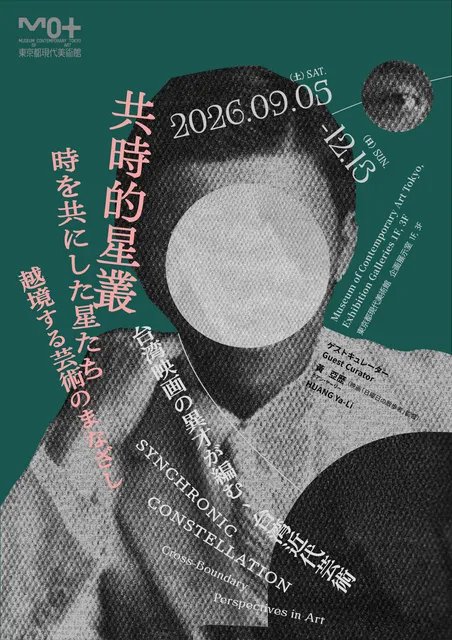
The exhibition takes as its starting point a film about the Fengche Poetry Society, a modernist poetry group formed in Taiwan in the 1930s, and uses it to look again at modern Taiwan and Japan through a wide range of cultural and artistic production. Roughly 200 art works and several hundred documents from modern Taiwan are brought together with about 100 works from Japan. Arranged so that their relationships cross and interweave like countless stars, they invite a reconsideration of the modern era from a present-day viewpoint.
The film at the centre of the project, Sunday Walkers (2015, released in Japan in 2017), follows several poets who tried to introduce Surrealism to Taiwan during the period of Japanese rule and who wrote poetry in Japanese. It offers no fixed narrative, leaving each viewer to find their own perspective. Its director, Huang Ya-li, serves as guest curator of the exhibition.
The film's way of thinking and editing is carried into the gallery space. Art works and materials from literature, film, music, theatre and dance are combined montage-style across six chapters, joined by video, reflective materials and a deliberately meandering route devised under Huang Ya-li's direction, so that the space itself becomes a device for producing crossings between multiple relationships, the viewer included. Individual endeavours that certainly existed in modern Taiwan and Japan each carried their own light, and even when not adjacent they shared a time and were linked like a constellation.