
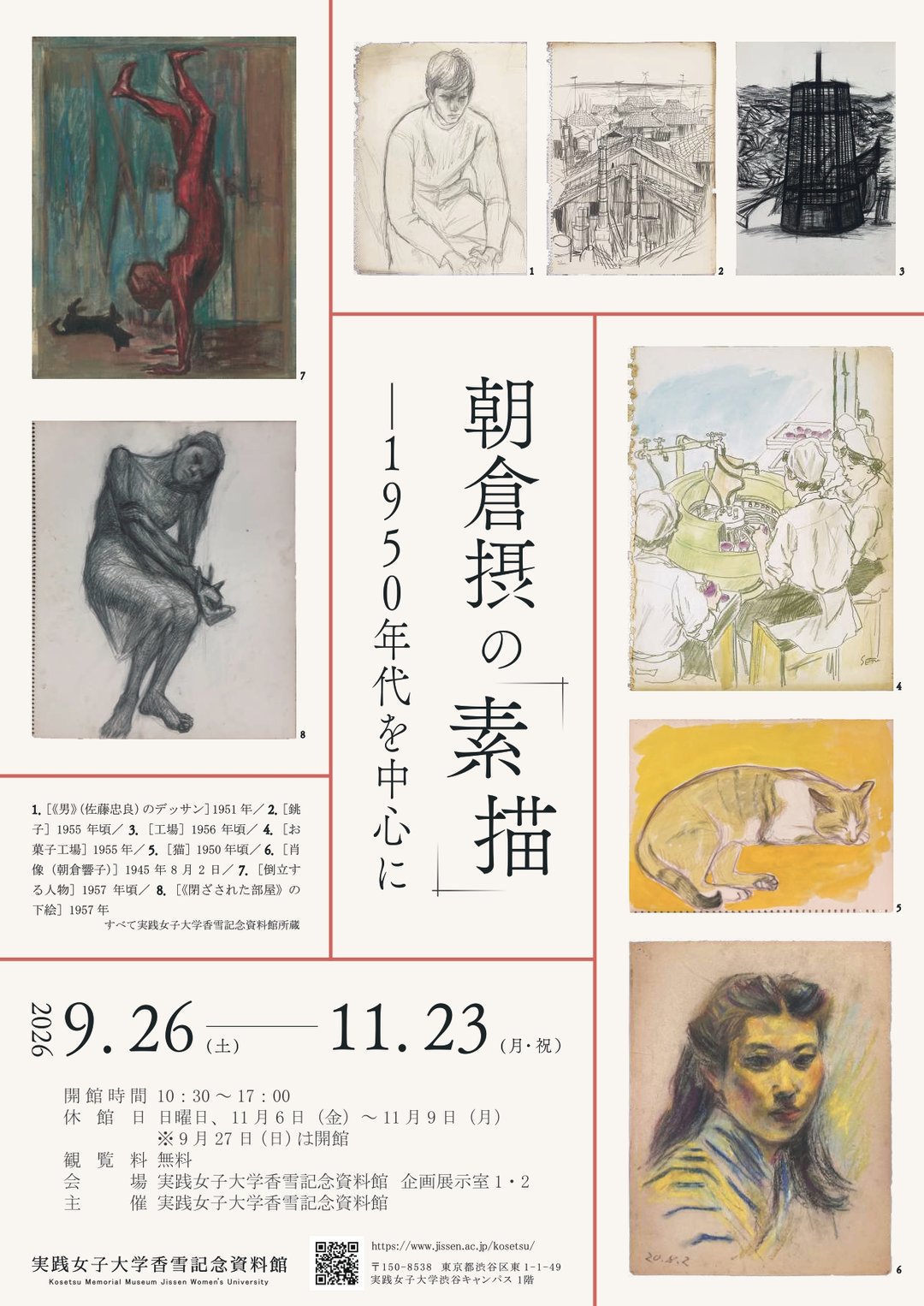
The exhibition focuses on Setsu Asakura's drawings from the 1950s, a decade of rapid development in her career. It follows an earlier 2017 show that surveyed her paintings, sketches, stage designs and picture-book illustrations from the 1940s to the 1960s; this one draws on sketchbooks and other works donated to the museum after her death. Asakura (1922–2014) was the daughter of the sculptor Fumio Asakura, and her sister Kyoko also worked as a sculptor.
She studied painting from an early age and entered the studio of Ito Shinsui at 17, but after the war she moved freely between Japanese-style and Western painting in search of new forms of expression. In 1950 she held her first solo exhibition at the Hokuso Gallery and won an encouragement prize at the Sobi Art Exhibition. Around the middle of the decade she travelled repeatedly with the painters and sculptors Tadashi Sato, Yoshio Mori and Tai Nakatani, among others, sketching in coal-mining, fishing and farming villages, where the group pushed one another to portray the reality of how people lived.
She built a house in Yoyogi and took on work documenting factory workers and others to support herself, and drew covers and illustrations for cheap magazines, simplifying her line with printing in mind. She also turned her attention to the changing city, producing large works that indicted the distortions of postwar society. Asakura seems to have had little wish to preserve her own work, and many pieces are lost.