
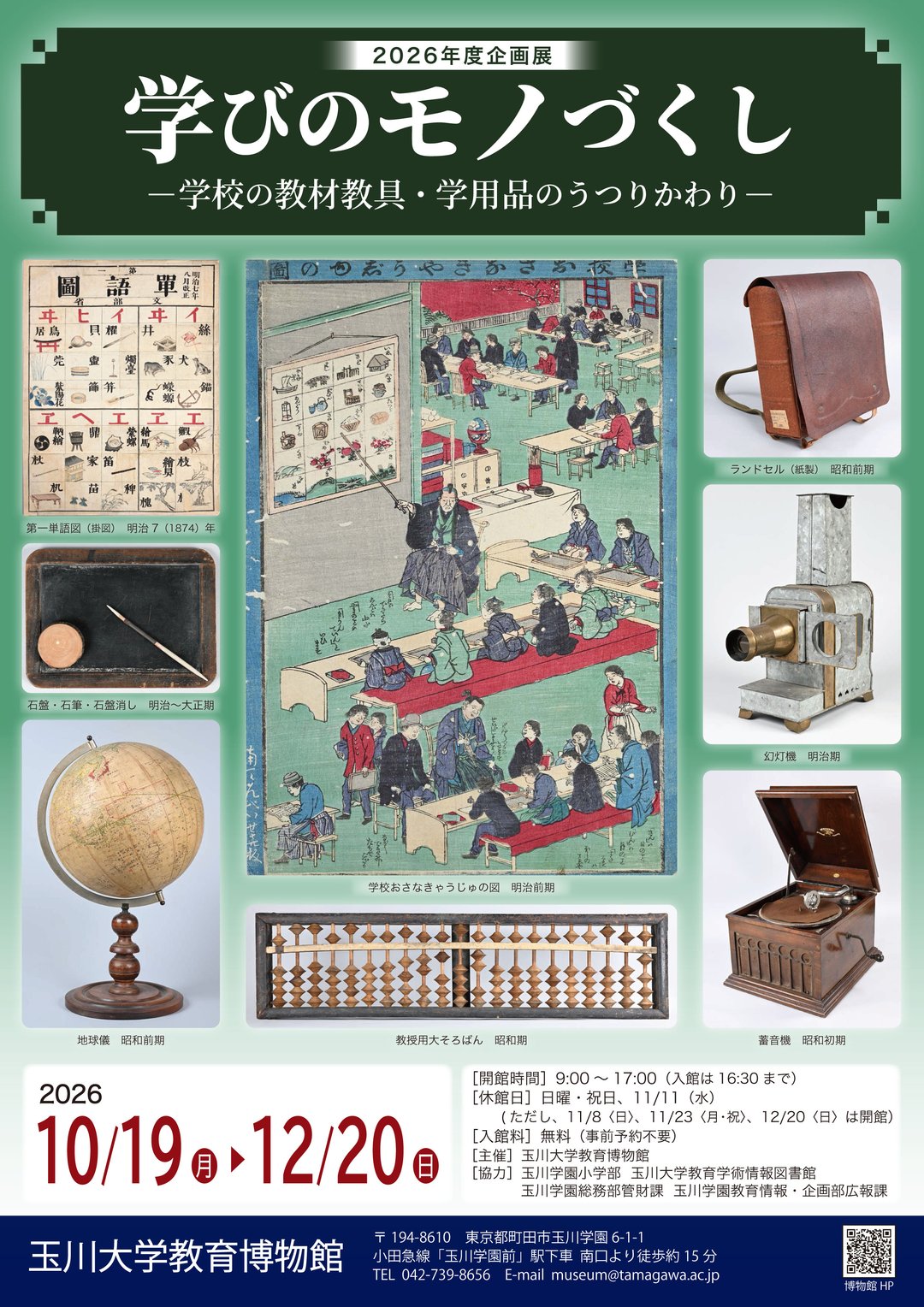
The exhibition looks at the teaching tools and school supplies used in Japanese elementary schools from the Meiji period onward, grouping them by function and form. It asks how these objects made the curriculum concrete and how they supported teaching and learning. In the Meiji period, as a modern school system took shape, lessons relied on textbooks along with slate boards and slate pencils, brushes, ink, inkstones and the abacus.
Specimens, models, maps and wall charts were brought in as teaching began to emphasise observing real things. From the Taisho period into the early Showa years, an education that valued children's independence brought a fuller range of materials for hands-on study: laboratory equipment, craft tools and musical instruments. School supplies became more standardised in this period, while wartime shortages forced the use of substitutes, so the supplies themselves reflect the times.
After the war, under the ideal of democratic education, teaching materials were reorganised to encourage pupils to learn on their own initiative. Audiovisual education gained importance, and projectors, slides, records and later television, video and overhead projectors came into wide use. In recent years these tools have taken on a new role in ICT-based learning.