
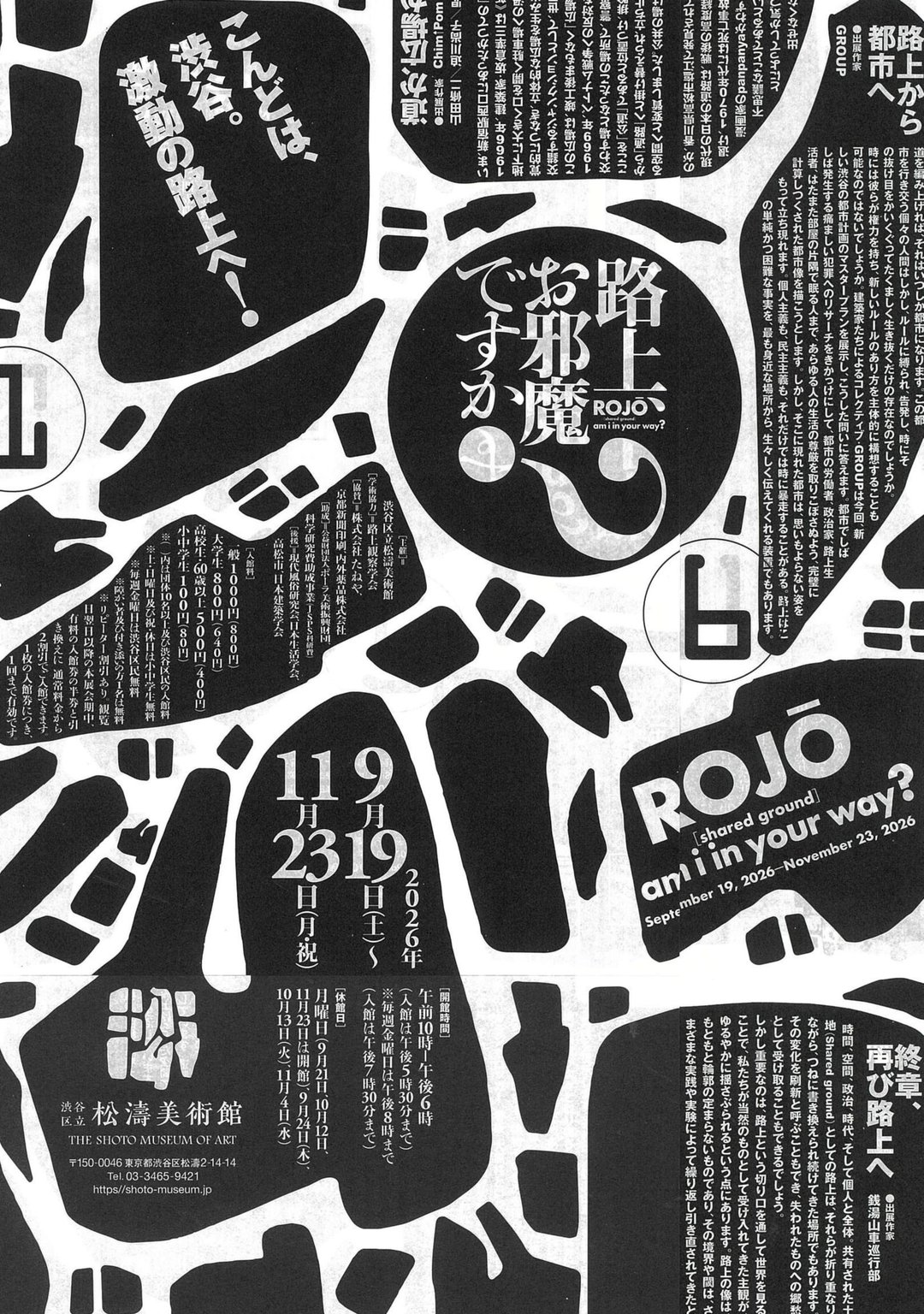
Japan once had spaces called kugai, areas outside the reach of established systems and authority. Found around temple and shrine gates and in post towns, they took in travellers and performers and served as devices for nurturing culture and exchange. The street in the present day does not fully overlap with those historical spaces, but because ownership and governance there are ambiguous, people have sought freedom in the street, sometimes through resistance to systems.
The street is not simply a symbol of freedom or liberation, however. Through a logic of exclusion it also carries discomfort and instability. Taking the street as its keyword, this exhibition considers the problems of publicness, which grows ever more complex today, through works that can be shown, historical events and discourse.
The exhibition also takes as an occasion the 40th anniversary of the founding in 1986 of the Street Observation Society. Formed by Genpei Akasegawa, Terunobu Fujimori and others, the society shared through media an eye that took up with amusement the situations unintentionally produced by city and nature rather than works of art made with intent. It conveyed the richness of the street while also carrying a critique of cities made homogeneous by development.