
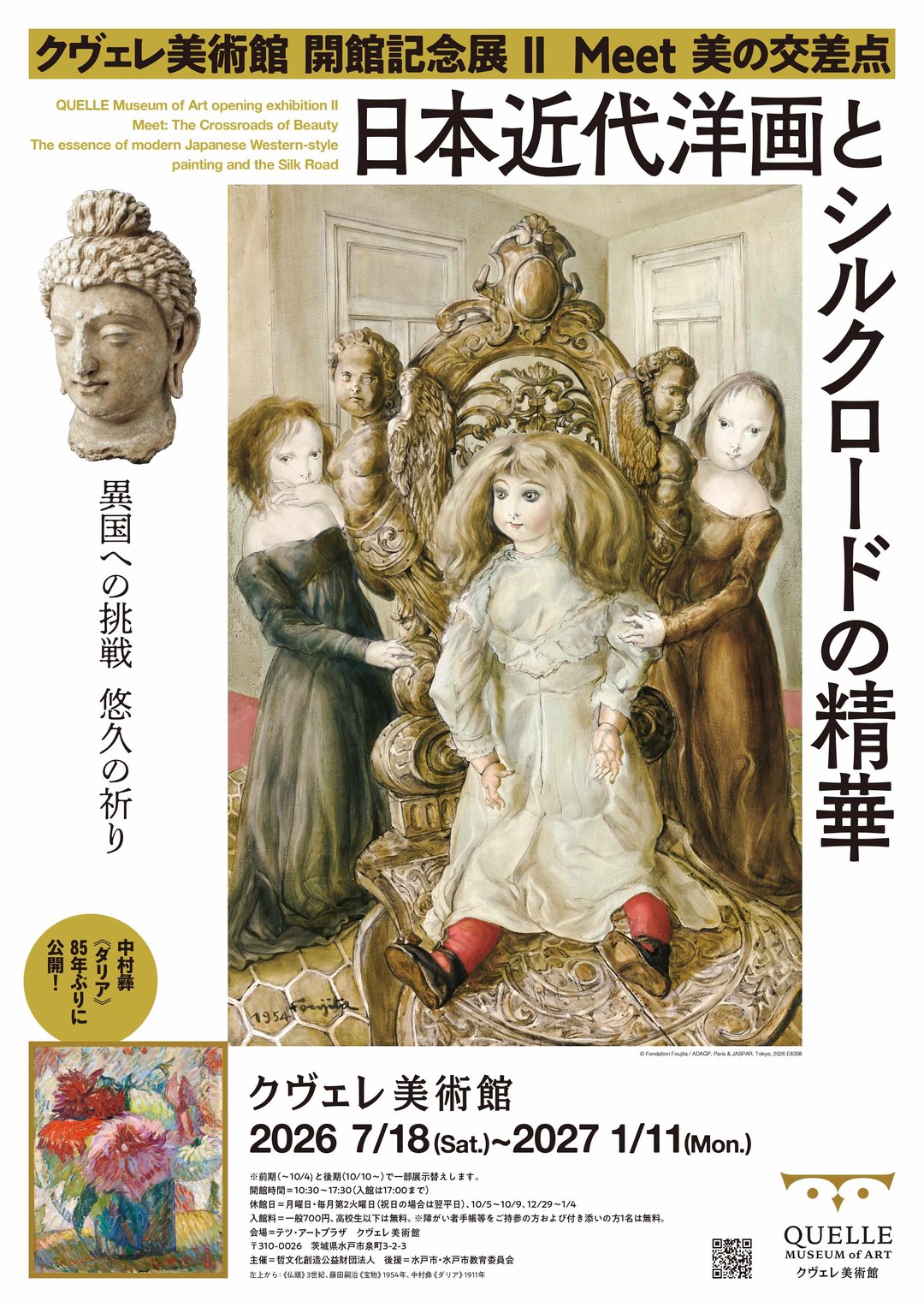
The exhibition brings together selected masterpieces of modern Japanese Western-style painting and craft works connected to the Silk Road. The painting section takes as its theme the challenge of foreign lands. In an era when the West was still a distant place, Asai Chū, Okada Saburōsuke and Fujishima Takeji crossed the sea, encountered new ways of handling light and colour, and opened up their own modes of expression.
Fujita Tsuguharu, Saeki Yūzō and Kuniyoshi Yasuo likewise refined their sense of beauty within overseas art and cultivated their individual characters. Meanwhile Kishida Ryūsei and Yorozu Tetsugorō, who stayed in Japan, deepened Western influence inwardly and brought it to original expression. Among these, Nakamura Tsune, a native of Mito, is represented by Dahlia (1911), in which admiration for Cézanne and Van Gogh appears as vivid vitality; the work is shown for the first time in 85 years, since a 1941 exhibition of his oil paintings held after his death.
Longing for distant lands is unchanged across time and place. The Silk Road, the trade route crossing the Eurasian continent, carried new things to each region and stimulated its culture. Centred on Chang'an, its starting point, Tang-dynasty China produced a brilliant culture in which the cultures of many regions merged.